Vitamin and mineral interactions explained simply
Vitamins and minerals are often discussed as if they act independently. In reality, many nutrients interact at the level of absorption, transport, or metabolism.
These interactions aren’t a flaw — they’re a feature of human biology. The issue arises when supplements ignore them.
Supportive interactions
Some nutrients are known to work together in predictable ways.
Vitamin C improves the absorption of non-heme iron.
Vitamin D relies on magnesium for activation.
Vitamin K supports calcium handling alongside vitamin D.
These pairings are well documented and are examples of nutrients supporting each other’s function.
Competitive interactions
Other nutrients can compete when taken together, particularly at higher doses.
Minerals such as calcium, magnesium, zinc, and copper share absorption pathways. When large amounts are consumed at the same time, the body may absorb less of one or more of them.
This doesn’t mean these nutrients shouldn’t be taken — it simply means spacing and balance matter.
Why this matters in supplements
Many multi-ingredient supplements include dozens of nutrients in one dose. While this looks comprehensive, it doesn’t account for competition or differing absorption needs.
Understanding interactions helps explain why some supplements underperform, even when the label looks impressive.
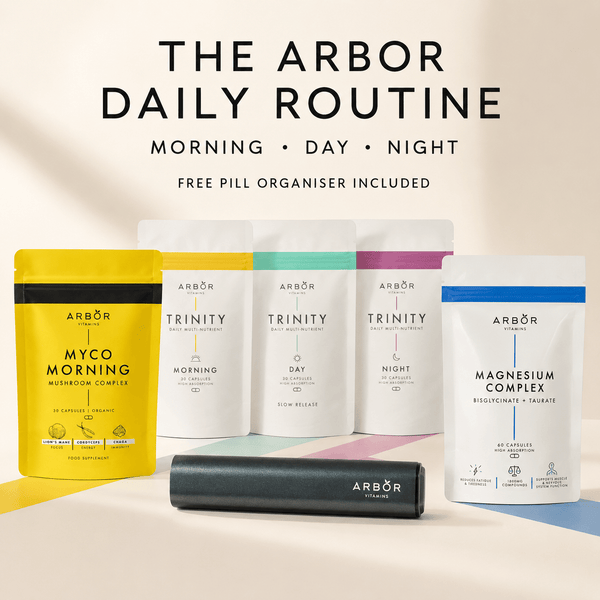
Our product TRINITY looks to solve this headache.
👉 This is one of the reasons discussed in our main article on why taking all your vitamins at once doesn’t always work.
HERE