Fruiting Body vs Mycelium: What's the Difference? (And Which Should You Choose?)
Quick Answer
If you've been researching mushroom supplements, you've probably seen brands claiming they're made from 100% fruiting body or warning you to avoid mycelium altogether. The reality is more nuanced.
Both fruiting body and mycelium contain naturally occurring compounds that have been studied for their potential health benefits. However, they're different parts of the same organism, and the quality of a mushroom supplement depends on far more than simply whether it contains fruiting body or mycelium.
For most consumers, the biggest issue isn't fruiting body vs mycelium—it's transparency. Some mycelium supplements are grown on grain and may contain a significant proportion of the growing substrate, while others use purified mycelium. Likewise, not all fruiting body supplements are extracted or manufactured to the same standard.
In this guide, we'll explain:
-
What fruiting body and mycelium actually are.
-
Why the debate exists.
-
What the scientific evidence says.
-
How to identify a high-quality mushroom supplement.
At a Glance
| Question | Answer |
|---|---|
| Are fruiting body and mycelium the same? | ❌ No. They're different parts of the same fungus. |
| Is fruiting body always better? | ❌ Not necessarily. It depends on the mushroom species and product quality. |
| Is mycelium always low quality? | ❌ No. Pure mycelium contains valuable compounds, but products grown on grain should clearly disclose this. |
| What's most important when choosing a supplement? | ✅ Transparent ingredients, quality extraction methods and independent testing where possible. |
Fruiting Body vs Mycelium: The Key Differences
Although they're part of the same fungus, the fruiting body and mycelium have different roles in the mushroom's life cycle and can differ in their composition depending on the species, how they're grown and how they're processed.
| Feature | Fruiting Body | Mycelium |
|---|---|---|
| What is it? | The visible mushroom that grows above the surface. | The underground network of thread-like fibres (hyphae) that forms the main body of the fungus. |
| Main role | Produces and releases spores for reproduction. | Absorbs nutrients and supports the growth of the fungus. |
| Visible to us? | ✅ Yes | ❌ Usually hidden beneath the growing surface. |
| Contains bioactive compounds? | ✅ Yes | ✅ Yes |
| Used in supplements? | Very commonly | Commonly, although products vary considerably. |
| Can be grown on grain? | ❌ No | ⚠️ Yes. Some commercial products include the grain substrate as part of the finished ingredient. |
| Extraction often used? | Frequently | Frequently |
The important thing to understand is that this isn't a case of one being "real mushroom" and the other being "fake." Both are genuine parts of the fungal organism and both contain naturally occurring compounds that have been studied for their potential health benefits.
The real question is how the ingredient was grown, extracted and tested—topics we'll explore in the next sections.
Why Is There So Much Debate?
If you've compared mushroom supplements online, you've probably seen brands making bold claims such as "100% fruiting body" or warning consumers to "avoid mycelium at all costs." In reality, the science is more nuanced than many marketing messages suggest.
The debate largely stems from how some mycelium supplements are produced.
Many commercial mycelium products are grown on a grain-based substrate, such as rice or oats. During manufacturing, some products are harvested and dried together with this growing medium. As a result, the finished ingredient may contain both fungal mycelium and grain material.
This matters because grain naturally contains starch, which can dilute the concentration of mushroom-derived compounds in the finished product if it isn't removed or clearly disclosed.
However, that doesn't mean all mycelium supplements are poor quality. Pure mycelium contains its own unique bioactive compounds, and some species—including Lion's Mane—contain compounds within the mycelium that have attracted significant scientific interest.
Likewise, not all fruiting body supplements are automatically superior. The quality of the raw material, extraction method, species used and manufacturing standards all influence the final product.
As a consumer, it's often more useful to ask:
-
Does the manufacturer clearly state whether they use fruiting body, mycelium or both?
-
Is the extraction method explained?
-
Is the product tested for key compounds, such as beta-glucans?
-
Are the ingredients fully transparent?
These questions are usually far more informative than marketing claims alone.
What Does the Scientific Evidence Say?
The current evidence doesn't support a simple conclusion that fruiting body is always better than mycelium or vice versa.
Instead, the answer depends on which mushroom species you're looking at, which compounds are being studied and how the supplement has been produced.
For example:
-
Beta-glucans are found in both fruiting bodies and mycelium, although their concentration can vary depending on the species, cultivation method and extraction process.
-
Lion's Mane contains compounds called hericenones, which are primarily associated with the fruiting body, while erinacines are mainly found in the mycelium. Both groups of compounds have attracted scientific interest, but they aren't interchangeable.
-
Some human clinical studies have used fruiting body extracts, while other laboratory and animal studies have investigated mycelium-derived compounds. This means it's important not to generalise findings from one type of ingredient to another.
Evidence Snapshot
| Statement | Current Evidence |
|---|---|
| Fruiting bodies contain bioactive compounds | ✅ Strong |
| Mycelium contains bioactive compounds | ✅ Strong |
| Fruiting body is always superior | ❌ Not supported by current evidence |
| Grain-grown mycelium products can contain significant amounts of starch | ✅ Well established |
| Product quality depends on cultivation, extraction and testing | ✅ Strong |
The takeaway is that the quality of a mushroom supplement is determined by far more than whether it contains fruiting body or mycelium. Looking at the species, extraction method, transparency of the label and independent testing will usually tell you much more about the product than a single marketing claim.
How to Choose a High-Quality Mushroom Supplement
Whether you choose a fruiting body extract, a mycelium product or a blend of both, there are a few key features that can help you identify a high-quality supplement.
1. Check Which Part of the Mushroom Is Used
A reputable manufacturer should clearly state whether the product contains:
-
Fruiting body
-
Mycelium
-
Or a combination of both
If this isn't disclosed, it can be difficult to know exactly what you're buying.
2. Look for Transparent Extraction Methods
Extraction helps release many of the mushroom's naturally occurring compounds.
Look for manufacturers that explain how their mushrooms are extracted, such as:
-
Hot water extraction – commonly used to extract beta-glucans.
-
Dual extraction – combines water and alcohol to extract a broader range of compounds for certain mushroom species.
Simply stating "mushroom extract" without further information tells you very little about the finished product.
3. Check for Standardisation or Independent Testing
Where possible, choose supplements that provide information about:
-
Beta-glucan content.
-
Third-party testing.
-
Quality assurance.
-
Species identification using the Latin name.
These details demonstrate transparency and help consumers compare products more objectively.
4. Be Wary of Marketing Claims
Claims such as "10:1 extract", "ultra-strength" or "maximum potency" don't automatically mean a product is higher quality. Without information about extraction methods, testing or active compounds, these claims can be misleading.
Pharmacist's Checklist
Before buying a mushroom supplement, ask yourself:
✔ Does it clearly state the mushroom species?
✔ Does it tell you whether it contains fruiting body, mycelium or both?
✔ Is the extraction method explained?
✔ Is the manufacturer transparent about quality testing?
✔ Does the label avoid vague marketing language and proprietary blends?
Ultimately, the best mushroom supplements aren't defined by a single ingredient or marketing claim—they're defined by quality, transparency and evidence-based formulation.
Pharmacist's Verdict: Which Should You Choose?
If you're looking for a simple answer, it's this:
Don't choose a mushroom supplement based solely on whether it contains fruiting body or mycelium. Choose it based on the quality of the evidence, the transparency of the manufacturer and the formulation as a whole.
While fruiting body extracts are widely used and feature in many human clinical studies, that doesn't automatically make every fruiting body supplement superior. Equally, mycelium shouldn't be dismissed simply because it's mycelium—what matters is whether you're getting pure mycelium or a product that contains a substantial amount of grain substrate.
As a pharmacist, these are the factors I'd prioritise:
-
The correct mushroom species for the intended purpose.
-
Clear disclosure of whether the product contains fruiting body, mycelium or both.
-
Transparent extraction methods that are appropriate for the mushroom being used.
-
Independent quality testing or standardisation where available.
-
Minimal unnecessary fillers and honest, evidence-based marketing.
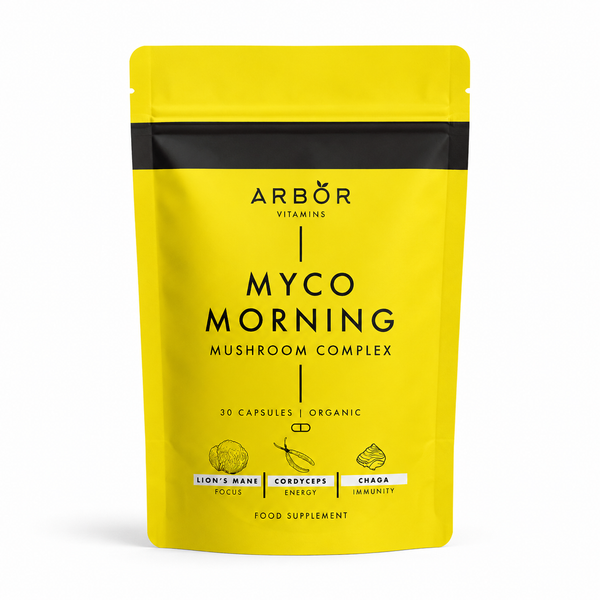
At Arbor Vitamins, we chose 100% fruiting body mushrooms for MYCO Morning because of their established use in the scientific literature, transparent sourcing and alignment with our formulation philosophy. That said, we recognise that both fruiting body and mycelium contain naturally occurring bioactive compounds, and the most important factor is always the quality of the finished product—not simply which part of the mushroom appears on the label.
A well-made mushroom supplement should leave you feeling confident about what's in it, how it was produced and why those ingredients were chosen. If that information isn't easy to find, it's worth asking why.
Frequently Asked Questions
Is fruiting body better than mycelium?
Not always. Both fruiting body and mycelium contain naturally occurring bioactive compounds, and both have been studied in scientific research. The more important consideration is the quality of the ingredient, how it was grown, extracted and tested, rather than simply which part of the mushroom was used.
Why do some companies only use fruiting body?
Many manufacturers prefer fruiting body because it has been used in numerous human clinical studies and doesn't contain grain substrate. It also aligns with consumer demand for minimally processed mushroom ingredients.
Is mycelium just filler?
No. Pure mycelium is a genuine part of the fungus and contains its own unique bioactive compounds. However, some commercial mycelium products are grown on grain and harvested before the grain has been removed, meaning the finished ingredient may contain a significant amount of starch alongside the mycelium.
Does fruiting body contain more beta-glucans?
Not necessarily. Beta-glucan content varies depending on the mushroom species, cultivation method, extraction process and manufacturing quality. Two fruiting body supplements can have very different beta-glucan levels, just as two mycelium products can.
Are mushroom extract ratios like 10:1 or 20:1 important?
Extract ratios can be useful, but they don't tell the whole story. Without information about the extraction process, beta-glucan content or quality testing, a high extract ratio doesn't automatically mean a better supplement.
What should I look for on a mushroom supplement label?
A high-quality mushroom supplement should clearly state:
-
The mushroom species (using its Latin name where possible).
-
Whether it contains fruiting body, mycelium or both.
-
The extraction method used.
-
Any standardisation or independent quality testing.
-
A transparent ingredients list without unnecessary fillers or proprietary blends.
Why does Arbor Vitamins use fruiting body mushrooms?
At Arbor Vitamins, we chose 100% fruiting body extracts because they align with our formulation philosophy of transparency, quality and evidence-based supplementation. We also clearly disclose our extraction methods and avoid unnecessary fillers, allowing customers to understand exactly what they're taking.
What's the most important factor when choosing a mushroom supplement?
Rather than focusing on a single marketing claim, look for a product from a reputable manufacturer that is transparent about its ingredients, extraction methods, quality testing and sourcing. In most cases, these factors are a better indicator of quality than whether the supplement contains fruiting body or mycelium alone.
Further Reading
If you found this guide helpful, you may also be interested in:
Learn About Functional Mushrooms
-
Lion's Mane Benefits: What Does the Evidence Say?
-
Chaga Benefits: What Does the Evidence Say?
-
Cordyceps Benefits: What Does the Evidence Say?
-
Reishi Benefits: What Does the Evidence Say?
-
Hot Water vs Dual Extraction: What's the Difference?
-
How to Choose a High-Quality Mushroom Supplement
Mushroom Safety
-
Do Mushroom Supplements Interact with Medications?
-
Lion's Mane and Sertraline: Can You Take Them Together?
-
Lion's Mane and ADHD Medication: Can You Take Them Together?
-
Chaga and Diabetes Medication: Can You Take Them Together?
-
Reishi and Blood Thinners: Can You Take Them Together? (Coming Soon)
References
-
Wasser SP. Medicinal Mushrooms as a Source of Antitumor and Immunomodulating Polysaccharides. Applied Microbiology and Biotechnology.
-
Friedman M. Chemistry, Nutrition, and Health-Promoting Properties of Hericium erinaceus (Lion's Mane) Mushroom Fruiting Bodies and Mycelia. Journal of Agricultural and Food Chemistry.
-
European Food Safety Authority (EFSA). Scientific Opinion on Beta-Glucans.
-
Memorial Sloan Kettering Cancer Center. About Herbs: Medicinal Mushrooms.
-
Hobbs C. Medicinal Mushrooms: The Essential Guide.
-
Li IC, et al. Neurohealth Properties of Hericium erinaceus Mycelia Enriched with Erinacines. Frontiers in Aging Neuroscience.
-
National Center for Complementary and Integrative Health (NCCIH). Medicinal Mushrooms.