Best Time to Take Vitamin E: Morning or Night? A Pharmacist Explains
Vitamin E can be taken in the morning or at night. There is no proven advantage to taking it at a particular time of day.
What matters more is taking vitamin E with a meal containing some fat, because it is a fat-soluble vitamin. Choose the meal and time that fit your routine most consistently.
Quick Answer
The best time to take vitamin E is with a fat-containing meal, whether that is breakfast, lunch or dinner.
-
Take it in the morning if breakfast contains foods such as eggs, yoghurt, nuts, seeds or avocado.
-
Take it in the evening if dinner is your largest or most reliable meal.
-
Avoid taking it on an empty stomach where possible.
-
Consistency matters more than the exact hour.
Vitamin E Timing at a Glance
| When to Take Vitamin E | Is It Suitable? | What to Know |
|---|---|---|
| Morning | Yes | A good option when breakfast contains some dietary fat. |
| Evening | Yes | Often convenient if dinner is your largest meal or you take other supplements at night. |
| Before bed | Yes | Vitamin E is not considered stimulating, but it should ideally be taken with food. |
| On an empty stomach | Not ideal | Vitamin E is absorbed more effectively when dietary fat is present. |
Does the Time of Day Really Matter?
Not significantly.
Vitamin E is a fat-soluble nutrient, meaning the body absorbs it alongside dietary fat. The contents of the meal are therefore more important than whether the clock says 8 a.m. or 8 p.m.
You do not need to take vitamin E at exactly the same hour every day. Instead, attach it to a regular meal that contains some fat and that you are unlikely to skip.
Pharmacist’s Verdict
For most people, the best time to take vitamin E is simply with their most reliable fat-containing meal.
Morning and evening are both suitable. There is no convincing evidence that vitamin E works better at night, improves daytime antioxidant protection when taken in the morning, or must be taken a set number of minutes after eating.
Should You Take Vitamin E in the Morning or at Night?
Both morning and evening are suitable times to take vitamin E. The better choice depends mainly on which meal contains some dietary fat and when you are most likely to remember your supplement.
Taking Vitamin E in the Morning
Morning may suit you if breakfast is a regular meal and includes a source of fat, such as:
-
Eggs.
-
Full-fat yoghurt.
-
Nuts or nut butter.
-
Seeds.
-
Avocado.
-
Olive oil.
Taking vitamin E with breakfast may also be easier if you already have an established morning supplement routine.
However, a light breakfast consisting only of black coffee, fruit or dry toast may not provide much fat. In that situation, lunch or dinner may be a better option.
Taking Vitamin E at Night
Evening is equally appropriate, particularly if dinner is your largest or most balanced meal.
Taking vitamin E with dinner may work well if:
-
You frequently skip breakfast.
-
Your evening meal usually contains more fat.
-
You already take supplements such as magnesium or zinc at night.
-
An evening routine is easier for you to follow consistently.
Vitamin E does not need to be taken at night to work effectively. The benefit is convenience and the opportunity to take it alongside a suitable meal—not a special night-time effect.
Can You Take Vitamin E Before Bed?
Yes, but ideally take it with dinner rather than on an empty stomach immediately before going to sleep.
Vitamin E is not considered stimulating and is not known to commonly interfere with sleep. If your supplement contains other ingredients, check the complete label, as a multi-ingredient product may include nutrients or stimulants that affect people differently.
Morning vs Night: Which Is Better?
| Morning may be better if… | Evening may be better if… |
|---|---|
| You eat a fat-containing breakfast | Dinner is your largest meal |
| You remember supplements more reliably in the morning | You already have an evening supplement routine |
| You prefer to finish your supplements early in the day | You regularly skip breakfast |
| Your evening meals are unpredictable | Breakfast is low in fat |
The Key Point
Vitamin E does not become more effective simply because it is taken in the morning or at night.
Choose the time that allows you to take it regularly and with food containing some fat. For many people, dinner is the easiest option, but a suitable breakfast or lunch works just as well.
Should Vitamin E Be Taken With Food?
Yes. Vitamin E is a fat-soluble vitamin, so it is absorbed more effectively when taken with a meal or snack containing some dietary fat.
You do not need an unusually fatty meal. A normal serving of food containing healthy fats is generally sufficient.
Suitable options include:
-
Eggs.
-
Full-fat yoghurt.
-
Nuts or nut butter.
-
Seeds.
-
Avocado.
-
Olive or rapeseed oil.
-
Oily fish.
For example, vitamin E could be taken with yoghurt and nuts at breakfast, a salad containing olive oil at lunch, or a balanced evening meal.
What Happens if You Take Vitamin E on an Empty Stomach?
Taking vitamin E without food is unlikely to be harmful, but absorption may be less reliable because there is little dietary fat available to support the digestive processes used to absorb it.
There is no need to repeat the dose if you accidentally take it without food. Simply take your next scheduled dose with a meal.
Does Vitamin E Need to Be Taken After Food?
Vitamin E can be taken:
-
During a meal.
-
Immediately after eating.
-
With a fat-containing snack.
There is no evidence that you must wait exactly 30 minutes after eating. The important factor is that food containing some fat is present around the time you take it.
Should You Take Vitamin E With Your Largest Meal?
Not necessarily.
Your largest meal may be a convenient choice because it is more likely to contain dietary fat, but a smaller meal or snack can also be suitable.
Choose whichever meal:
-
Contains some fat.
-
You eat consistently.
-
Fits naturally into your supplement routine.
-
Does not make you feel nauseous or uncomfortable.
Can Vitamin E Be Taken With Other Fat-Soluble Vitamins?
Vitamin E is often included in multivitamins alongside vitamins A, D and K.
At ordinary nutritional doses, these vitamins do not automatically need to be separated. However, taking several high-dose fat-soluble vitamin supplements together is not advisable unless recommended by a healthcare professional, as these nutrients can accumulate in the body.
Check the combined amounts across all supplements you use to avoid accidentally taking unnecessarily high doses.
The Key Point
Take vitamin E with a normal meal or snack that contains some dietary fat.
There is no need for an exact amount of fat, a particularly large meal or a strict waiting period after eating. A consistent routine with breakfast, lunch or dinner is more useful than trying to follow an unnecessarily complicated schedule.
Do You Need a Vitamin E Supplement?
Most healthy adults should be able to obtain enough vitamin E from a varied, balanced diet.
The NHS advises that adults need approximately:
-
4 mg per day for men
-
3 mg per day for women
Vitamin E is stored in the body, so it does not need to be consumed in exactly the same amount every day.
Who Might Need Additional Vitamin E?
Vitamin E deficiency is uncommon in otherwise healthy people. Supplementation may be recommended when someone has a diagnosed deficiency or a condition that affects the absorption of dietary fat.
This may include certain people with:
-
Crohn’s disease.
-
Cystic fibrosis.
-
Disorders affecting bile production or release.
-
Long-term fat malabsorption.
-
Rare inherited conditions affecting vitamin E metabolism.
These situations may require specialist forms or doses of vitamin E and should be managed with appropriate medical advice.
Does Vitamin E Improve Skin Health?
Vitamin E contributes to the protection of cells from oxidative stress and helps maintain healthy skin.
However, taking additional vitamin E does not necessarily improve the appearance of the skin when someone is already obtaining enough from their diet. Evidence supporting oral vitamin E supplements specifically for clearer, younger-looking or more hydrated skin remains limited.
A supplement should therefore not be treated as a guaranteed solution for:
-
Dry skin.
-
Wrinkles.
-
Acne.
-
Scarring.
-
Hair growth.
-
General signs of ageing.
Anyone experiencing persistent skin symptoms should consider the underlying cause rather than automatically increasing their vitamin E intake.
Can You Get Enough Vitamin E From Food?
Good dietary sources include:
-
Sunflower, rapeseed, olive and other plant oils.
-
Almonds, hazelnuts and peanuts.
-
Sunflower seeds and other seeds.
-
Wheatgerm and fortified cereals.
-
Avocado.
-
Spinach and other green vegetables.
Nuts, seeds and plant oils provide both vitamin E and the dietary fat needed to absorb it.
Food or Supplements: Which Is Better?
For most people, food should be the main source of vitamin E.
A supplement may be useful when dietary intake is inadequate, vitamin E is included as part of an appropriately formulated multivitamin, or a healthcare professional has identified a specific need.
Taking a vitamin E supplement does not compensate for an unbalanced diet, and higher doses are not automatically more beneficial.
Pharmacist’s Perspective
Most adults do not need a standalone high-dose vitamin E supplement.
A sensible nutritional amount within a balanced multivitamin may help complement the diet, but supplementation should remain proportionate. The aim is to meet nutritional needs—not to take the highest available dose in the hope of gaining additional antioxidant, skin or anti-ageing benefits.
How Much Vitamin E Should You Take?
More vitamin E is not necessarily better.
The NHS advises that most adults should be able to obtain enough vitamin E from a varied diet. It states that supplements providing 540 mg or less per day are unlikely to cause harm, but this is a safety threshold—not a recommended daily dose or a target to aim for.
Most everyday multivitamins contain substantially smaller nutritional amounts. Follow the directions on your chosen product and avoid combining several supplements containing vitamin E without checking the total dose.
Can You Take Vitamin E Every Day?
Vitamin E can be taken daily when it is supplied at an appropriate nutritional dose.
However, routinely taking a high-dose standalone supplement is unlikely to provide additional benefits for most healthy people. Clinical trials have not shown that moderately high doses reliably prevent cardiovascular disease, and some studies have identified potential harms from long-term high-dose supplementation.
You should not use the maximum tolerable amount as a daily supplementation goal.
What Happens if You Take Too Much Vitamin E?
Vitamin E from food has not been associated with harmful effects. The concern relates mainly to large supplemental doses.
High-dose vitamin E may:
-
Interfere with normal blood clotting.
-
Increase the risk of bleeding.
-
Increase the risk of haemorrhagic stroke in some circumstances.
-
Cause problems when combined with certain medicines.
-
Provide no additional benefit when vitamin E intake is already sufficient.
A large clinical trial also found that 400 IU of synthetic vitamin E daily was associated with an increased risk of prostate cancer in the men studied. This does not mean ordinary dietary vitamin E causes prostate cancer, but it reinforces why high-dose supplements should not be taken routinely without a clear reason.
Does Vitamin E Interact With Medication?
Vitamin E supplements can interact with certain medicines, particularly at higher doses.
Blood Thinners and Antiplatelet Medicines
Speak to a pharmacist or doctor before taking a standalone vitamin E supplement if you use medicines that reduce blood clotting, including:
-
Warfarin.
-
Apixaban.
-
Rivaroxaban.
-
Clopidogrel.
-
Regular aspirin prescribed for cardiovascular protection.
Vitamin E can inhibit platelet aggregation and affect vitamin K-dependent clotting. Combining a large supplemental dose with an anticoagulant or antiplatelet medicine may therefore increase the risk of bleeding.
Do not stop or alter a prescribed medicine to take a supplement.
Cancer Treatment
Check with your oncology team before using high-dose antioxidant supplements during chemotherapy or radiotherapy. Evidence is not conclusive, but there is concern that some antioxidant supplements could affect how certain treatments work.
Simvastatin and Niacin
A combination of vitamin E and other antioxidant supplements has also been reported to affect the response to treatment with simvastatin and niacin. Anyone using this combination should check before adding a high-dose antioxidant formula.
Who Should Check Before Supplementing?
Seek professional advice before taking a high-dose vitamin E supplement if you:
-
Take anticoagulant or antiplatelet medication.
-
Have a bleeding disorder.
-
Are preparing for surgery.
-
Are receiving chemotherapy or radiotherapy.
-
Take several supplements containing fat-soluble vitamins.
-
Have been advised to restrict or monitor particular nutrients.
Pharmacist’s Perspective
A normal nutritional amount of vitamin E is very different from a high-dose standalone supplement.
For most people, the safest approach is to obtain vitamin E mainly through food or use a sensibly dosed multivitamin. Avoid assuming that a larger dose offers stronger antioxidant, skin or anti-ageing benefits.

Why Does TRINITY Put Vitamin E in Its Night Formula?
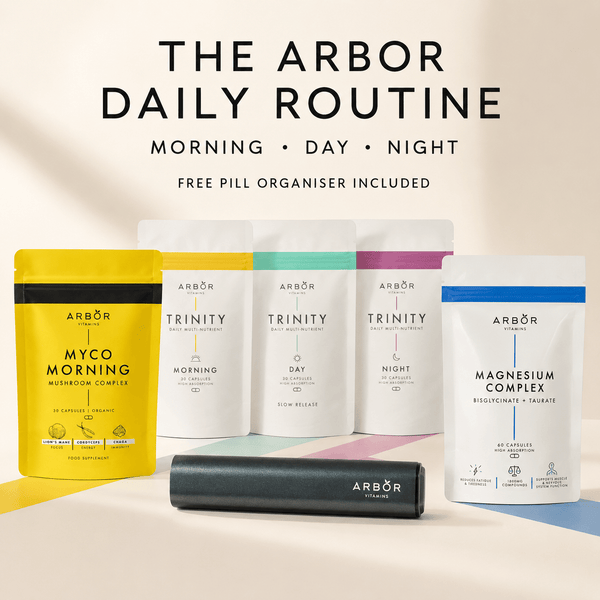
TRINITY includes vitamin E in its Night Formula, but this does not mean vitamin E inherently works better at night.
The placement is designed around a practical, divided supplement routine:
-
Dinner is often a reliable meal containing some dietary fat.
-
Many people find an evening supplement routine easy to remember.
-
Dividing nutrients between morning, daytime and evening avoids placing everything into one large capsule.
-
It allows vitamin E to be taken separately from the vitamin D3 and vitamin K2 included in the Day Formula.
The most important factor remains taking vitamin E consistently and with food. Someone using a different vitamin E supplement could take it with breakfast or lunch and still absorb it effectively.
Vitamin E in TRINITY
TRINITY uses natural d-alpha tocopherol, rather than synthetic dl-alpha tocopherol.
These forms are not equivalent by weight. Natural d-alpha tocopherol has greater biological activity than the same milligram amount of synthetic dl-alpha tocopherol.
It is included alongside magnesium, zinc and other nutrients in the Night Formula. This creates a convenient evening routine, but vitamin E does not need magnesium or zinc in order to be absorbed.
[Explore TRINITY]
What Should You Look for in a Vitamin E Supplement?
When comparing vitamin E products, check:
The Form of Vitamin E
Labels may show:
-
d-alpha tocopherol — natural-source vitamin E.
-
dl-alpha tocopherol — synthetic vitamin E.
-
Tocopheryl acetate or tocopheryl succinate — stabilised forms commonly used in supplements.
Do not compare products by milligrams or international units without also checking the form provided.
The Dose
Avoid assuming that a high-dose supplement is automatically more effective.
For most healthy adults, vitamin E should primarily come from food. Where a supplement is used, a sensible nutritional amount is generally more appropriate than a very high standalone dose unless a healthcare professional has recommended otherwise.
The Complete Ingredient List
Check whether the product contains:
-
Other vitamins or minerals.
-
Herbal ingredients.
-
Oils or carriers.
-
Fillers, colourings or preservatives.
-
Allergens.
This is particularly important when taking several supplements, as vitamin E may appear in more than one product.
Clear Directions
A trustworthy product should state:
-
The amount of vitamin E per serving.
-
The form used.
-
How many capsules or tablets make up one serving.
-
Whether it should be taken with food.
-
Relevant safety warnings.
Pharmacist’s Perspective
TRINITY places vitamin E at night because it fits naturally into a divided, meal-based supplement routine—not because the evidence shows that night is universally better.
Whether vitamin E is taken in the morning, at lunch or with dinner, the same principles apply: use an appropriate dose, take it with food containing some fat and check for potential medicine interactions.
Frequently Asked Questions
Is it better to take vitamin E in the morning or at night?
Neither time is inherently better.
Take vitamin E with whichever regular meal contains some dietary fat. Morning works well with a suitable breakfast, while evening may be more convenient if dinner is your largest meal.
Can I take vitamin E before bed?
Yes. Vitamin E is not considered stimulating and is not known to commonly interfere with sleep.
Ideally, take it with dinner or a fat-containing evening snack rather than on an empty stomach immediately before bed.
Does vitamin E make you sleepy?
There is no good evidence that vitamin E causes sleepiness or works as a sleep supplement.
Its placement in an evening supplement routine is usually based on convenience and meal timing rather than a sedative effect.
Should vitamin E be taken with food?
Yes. Because vitamin E is fat-soluble, it is best taken with a meal or snack containing some fat.
Suitable foods include eggs, yoghurt, nuts, seeds, avocado, olive oil and oily fish.
Can I take vitamin E with vitamin D?
Vitamin E and vitamin D can generally be taken together at ordinary nutritional doses. Both are fat-soluble, so taking them with food containing some fat supports absorption.
Check the combined amounts in all supplements you use, particularly if either product provides a high dose.
Can I take vitamin E with magnesium or zinc?
Yes. There are no well-established absorption conflicts between normal supplemental amounts of vitamin E, magnesium and zinc.
They can be taken together with an evening meal if that makes your routine easier, but the combination does not make vitamin E more effective.
Can I take vitamin E with blood thinners?
Check with your pharmacist, anticoagulant clinic or doctor before taking a standalone vitamin E supplement if you use an anticoagulant or antiplatelet medicine.
Higher supplemental doses may increase bleeding risk when combined with medicines such as warfarin, apixaban, rivaroxaban, clopidogrel or regular prescribed aspirin.
Do not stop or change your medicine without professional advice.
Is natural vitamin E better than synthetic vitamin E?
Natural-source vitamin E is usually listed as d-alpha tocopherol, while synthetic vitamin E is listed as dl-alpha tocopherol.
Natural d-alpha tocopherol has greater biological activity than the same weight of synthetic dl-alpha tocopherol. However, the dose, overall formulation and whether you need supplementation are also important.
Can I take vitamin E every day?
Vitamin E can be taken daily at an appropriate nutritional dose.
Most people do not need a high-dose standalone supplement, and taking more than your body requires does not guarantee additional benefits for your skin, immunity or general health.
What should I do if I miss a dose?
Take your next dose at the usual time.
Do not take twice the recommended amount to compensate for a missed dose. Missing an occasional dose is unlikely to make a meaningful difference.
What is the best time to take vitamin E for skin?
There is no proven best time for skin health.
Taking vitamin E in the morning rather than at night has not been shown to improve its effects on the skin. If you use a supplement, taking it consistently with a fat-containing meal matters more than the time on the clock.
Final Verdict
The best time to take vitamin E is with a meal containing some dietary fat.
Morning, lunchtime and evening can all work. Choose the meal you eat most consistently rather than trying to follow a strict time:
-
Take it with breakfast if breakfast contains some fat.
-
Take it with dinner if that is your largest or most reliable meal.
-
Avoid taking it on an empty stomach where possible.
-
Check before taking a high-dose supplement alongside blood-thinning medication.
Most healthy adults can obtain sufficient vitamin E through a varied diet. Where supplementation is appropriate, use a sensible dose and remember that more is not automatically better.
TRINITY places vitamin E in its Night Formula because dinner is often a reliable fat-containing meal and the divided routine is convenient—not because vitamin E only works at night.
[Explore TRINITY]
Further Reading
-
Morning vs Evening Supplements: Maximising Nutrient Absorption
-
When Should You Take Your Supplements? Best Times for Absorption and Energy
-
Best Vitamin Combinations for Maximum Absorption and Results
-
Vitamin and Mineral Interactions: How Nutrient Timing and Pairing Boost Absorption
References
-
NHS. Vitamins and Minerals: Vitamin E.
-
National Institutes of Health Office of Dietary Supplements. Vitamin E: Fact Sheet for Health Professionals.
-
Jeanes YM, Hall WL, Ellard S, Lee E, Lodge JK. The absorption of vitamin E is influenced by the amount of fat in a meal and the food matrix. British Journal of Nutrition. 2004;92(4):575–579.
-
Traber MG, Leonard SW, Ebenuwa I, et al. Vitamin E absorption and kinetics in healthy women, as modulated by food and by fat, studied using two deuterium-labelled alpha-tocopherols in a three-phase crossover design. American Journal of Clinical Nutrition. 2019;110(5):1148–1167.
-
Klein EA, Thompson IM, Tangen CM, et al. Vitamin E and the risk of prostate cancer: the Selenium and Vitamin E Cancer Prevention Trial. JAMA. 2011;306(14):1549–1556.
About the Author
Jon Wright is a Clinical Pharmacist and Co-Founder of Arbor Vitamins. Arbor’s supplements are formulated around nutrient form, compatibility and timing, with a focus on clear labelling and evidence-based doses.
Last reviewed: July 2026.
This article is for general information only and does not replace personalised medical advice. Speak to your pharmacist, GP or specialist before taking a high-dose vitamin E supplement, particularly if you use anticoagulant or antiplatelet medication, are preparing for surgery or are receiving cancer treatment.