Is Taking All Your Vitamins at Once a Bad Idea?
What Happens When You Stack Supplements in a Single Dose
It’s convenient.
One handful.
One glass of water.
Done for the day.
But is taking all your vitamins at once actually effective?
Or could stacking everything together reduce absorption and increase digestive stress?
The answer isn’t extreme.
It’s structural.
Let’s break it down.
What Happens When You Take Everything Together?
When you swallow multiple supplements at once, several things happen simultaneously:
-
Minerals dissolve and compete for transporters
-
Fat-soluble vitamins require bile release
-
Active transport systems may saturate
-
The stomach handles a high concentration load
-
Tablet coatings and binders dissolve
Your digestive system becomes a traffic junction.
And some nutrients share lanes.
1️⃣ Mineral Competition Begins Immediately
Certain minerals use overlapping absorption pathways.
For example:
-
Iron competes with calcium
-
Zinc influences copper balance
-
High-dose magnesium may reduce iron uptake
When taken together in meaningful doses, absorption efficiency may decline.
This doesn’t mean “zero absorption.”
But proportional uptake may drop.
👉 See: Vitamins You Shouldn’t Take Together (and Why Nutrient Timing Matters)

2️⃣ Active Transport Can Saturate
Some nutrients rely on energy-dependent carrier systems.
These systems are not unlimited.
Taking very high doses at once may:
-
Exceed optimal transport capacity
-
Increase excretion
-
Increase gastrointestinal discomfort
Splitting doses across the day may improve proportional absorption.
👉 Read: Does Splitting Supplements Improve Absorption?
3️⃣ Fat-Soluble Vitamins Need Food
Vitamins A, D, E and K require dietary fat.
If you take all your supplements:
-
On an empty stomach
-
With a low-fat snack
Fat-soluble absorption may be reduced.
👉 Learn more: How Vitamin & Mineral Absorption Actually Works
4️⃣ Digestive Load Matters
Large one-a-day stacks may:
-
Feel heavy
-
Increase nausea
-
Cause reflux
-
Slow dissolution
Especially when multiple minerals are compressed into one tablet.
See:
👉 Why Do I Feel Worse After Taking Vitamins?
5️⃣ Circadian Rhythm Is Ignored
Your body’s needs shift across the day.
Morning:
-
Energy metabolism
-
Iron utilisation
-
Cortisol peak
Evening:
-
Nervous system regulation
-
Muscle recovery
-
Magnesium tolerance
Taking everything at once ignores this rhythm.
👉 Read: Best Time to Take Vitamins: Morning vs Night
So… Is It “Bad”?
Not necessarily.
If doses are moderate and digestion is strong, taking everything together may still provide benefit.
But for optimisation — particularly with:
-
Competing minerals
-
Higher doses
-
Sensitive digestion
-
Long-term supplementation
Spacing nutrients may improve efficiency and tolerance.
What a Smarter Structure Looks Like
Instead of stacking everything, consider:
Morning:
-
Iron
-
B vitamins
Midday (with food):
-
Fat-soluble vitamins
Evening:
-
Magnesium
-
Calming minerals
Separating nutrients reduces competition and aligns with physiology.
How Structured Systems Address This
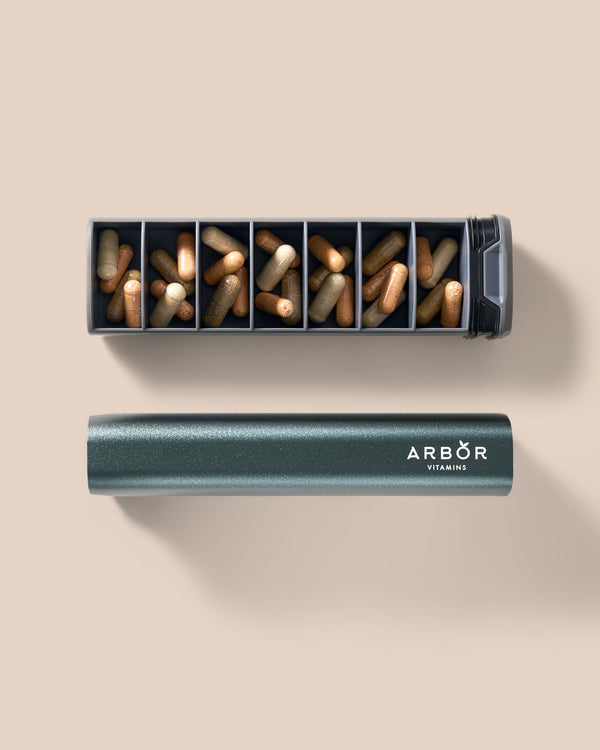
A structured multi-nutrient system separates nutrients across the day instead of compressing everything into one dose.
This may:
-
Reduce mineral bottlenecks
-
Improve tolerance
-
Improve proportional absorption
-
Align nutrients with biological rhythm
TRINITY Multi-Nutrients separates nutrients into:
-
Morning
-
Day
-
Night formulas
Designed to reduce unnecessary stacking and improve structural logic.
Explore the full formulation here:
👉 https://arborvitamins.com/products/trinity-formula
FAQ: Taking Vitamins All at Once
Is it bad to take all vitamins together?
Not always, but competing minerals and high single doses may reduce absorption efficiency.
Should I split my supplements?
Separating competing nutrients and aligning with meals may improve tolerance and uptake.
Does timing really matter?
Yes. Circadian rhythm, mineral competition and fat-dependent absorption all influence effectiveness.
Why do multivitamins combine everything?
Convenience and compliance are prioritised, but this may not always optimise absorption.
Final Thoughts
Taking all your vitamins at once isn’t automatically harmful.
But it may not be optimal.
Absorption is competitive.
Transport systems saturate.
Timing influences tolerance.
Convenience is simple.
Structure is strategic.