Does Splitting Supplements Improve Absorption?
The Science Behind Nutrient Timing and Mineral Competition
Taking a supplement once per day feels convenient.
But biologically, absorption isn’t always optimised by convenience.
The human body absorbs nutrients through tightly regulated transport systems. When large doses of multiple nutrients are taken together, absorption pathways can become saturated — or competitive.
So does splitting supplements across the day improve absorption?
In many cases, yes — but the reason isn’t magic.
It’s physiology.
1. The Core Concept: Absorption Is Limited & Regulated
Nutrients don’t absorb infinitely.
Some rely on:
-
Active transport proteins
-
Saturable carrier systems
-
Shared mineral pathways
When these systems are overloaded, absorption efficiency can decline.
If you haven’t yet read our foundational guide, start here:
👉 How Vitamin & Mineral Absorption Actually Works
2. Mineral Competition: Why Timing Matters
Certain minerals share intestinal transport pathways.
Examples:
-
Iron competes with calcium
-
Zinc competes with copper
-
Magnesium competes at higher doses
When taken together in high amounts, one mineral may reduce the uptake of another.
This doesn’t mean they “cancel each other out.”
But it can reduce efficiency.
Spacing them allows transport pathways to reset.
👉 For a deeper breakdown:
Vitamins You Shouldn’t Take Together (and Why Nutrient Timing Matters)
Taking Iron and Calcium Together? Why Timing Matters

3. Dose Saturation: More at Once ≠ More Absorbed
Some nutrients rely on active transport systems.
Active transport systems can become saturated.
For example:
-
Large doses of vitamin C may exceed transport capacity
-
High-dose magnesium may rely more heavily on passive diffusion
-
B12 requires intrinsic factor — a limited mechanism
Taking very high single doses may increase waste rather than uptake.
Splitting doses can:
-
Improve proportional absorption
-
Reduce digestive discomfort
-
Improve tolerance
4. Fat-Soluble Vitamins & Meal Timing
Fat-soluble vitamins (A, D, E and K) require dietary fat for absorption.
Taking them:
-
On an empty stomach
-
With very low-fat meals
May reduce uptake.
Spacing these vitamins with meals that contain fat can improve absorption efficiency.
👉 Related reading:
Best Time to Take Vitamins: Morning vs Night

5. Practical Example: One Large Dose vs Split Doses
Imagine a supplement containing:
-
Iron
-
Calcium
-
Zinc
-
Magnesium
All taken together.
Potential issues:
-
Iron competes with calcium
-
Zinc competes with copper balance
-
Magnesium absorption declines at higher doses
-
Active transport pathways may saturate
Now compare that to:
Morning:
-
Iron + vitamin C
Evening:
-
Magnesium
Separate timing may reduce bottlenecks.
Absorption isn’t necessarily doubled — but efficiency improves.
6. Does Splitting Always Improve Absorption?
Not always.
Water-soluble vitamins at moderate doses often absorb effectively regardless of timing.
But splitting may help when:
-
Doses are high
-
Minerals compete
-
Digestive tolerance is an issue
-
Active transport is involved
The goal is optimisation — not complication.
7. When Splitting Makes the Most Sense
Splitting supplements is particularly useful when:
-
Taking multiple minerals
-
Taking iron
-
Using higher-dose magnesium
-
Managing digestive sensitivity
-
Combining fat-soluble vitamins
It may be unnecessary for:
-
Low-dose single-nutrient supplements
-
Basic water-soluble vitamins at modest doses
Structure matters most when competition is likely.
8. A Simple Timing Structure
You don’t need a complex schedule.
For many people, this works:
Morning:
-
Iron
-
B vitamins
Midday:
-
Multinutrient blend (without heavy competing minerals)
Evening:
-
Magnesium
Take fat-soluble vitamins with meals that contain fat.
Avoid coffee around iron intake.
That’s often enough to reduce unnecessary bottlenecks.
9. Why Many One-a-Day Supplements Ignore This
Traditional multivitamins prioritise convenience.
Everything in one tablet.
But physiology doesn’t always favour that model.
If you’d like to see a detailed comparison:
👉 One-a-Day Multivitamins vs Structured Multi-Nutrient Systems
10. A Structured Approach
Rather than relying on large single-dose stacking, structured supplementation separates nutrients across the day.
This approach:
-
Reduces mineral competition
-
Aligns nutrients with biological rhythms
-
Improves digestive tolerance
-
Supports more consistent absorption
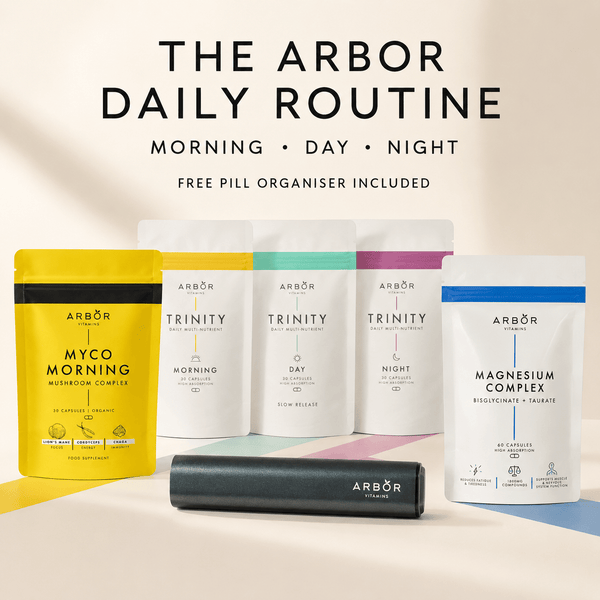
One example is TRINITY Multi-Nutrients, which separates nutrients into:
-
Morning
-
Day
-
Night formulas
Designed specifically to reduce unnecessary nutrient bottlenecks.
👉 Explore the full formulation here:
https://arborvitamins.com/products/trinity-formula
FAQ: Does Splitting Supplements Improve Absorption?
Does splitting supplements improve absorption?
In many cases, yes. Splitting can reduce mineral competition and prevent saturation of active transport systems, improving absorption efficiency.
Which supplements should not be taken together?
Iron and calcium are commonly separated. Zinc and copper balance also matters. High-dose minerals are often better spaced.
Is it better to take vitamins in the morning or evening?
It depends on the nutrient. B vitamins are often taken earlier in the day, while magnesium is commonly taken in the evening.
Does splitting increase the total amount absorbed?
Not necessarily, but it may improve proportional efficiency and reduce competition.
Final Thoughts
Splitting supplements isn’t about taking more.
It’s about respecting how the body absorbs nutrients.
Absorption is:
-
Regulated
-
Competitive
-
Saturable
-
Influenced by timing
When nutrients are structured intelligently, absorption bottlenecks can be reduced.
Convenience is simple.
Physiology is smarter.