Do Multivitamins Actually Do Anything?
What Science Says About Effectiveness & Absorption
Multivitamins are one of the most commonly used supplements in the world.
And also one of the most debated.
Some say they’re essential insurance.
Others say they’re a waste of money.
So — do multivitamins actually do anything?
The answer is nuanced.
They can.
But not all multivitamins are structured the same way.
What Multivitamins Are Designed to Do
A multivitamin is designed to:
-
Fill dietary gaps
-
Prevent deficiency
-
Support baseline nutrient sufficiency
-
Provide micronutrient “insurance”
They are not:
-
Instant energy boosters
-
Weight-loss pills
-
Miracle health shortcuts
Their primary function is sufficiency — not stimulation.
When Multivitamins Make the Most Difference
Research consistently shows multivitamins are most beneficial when:
-
Dietary variety is limited
-
Calorie intake is reduced
-
Nutrient absorption is suboptimal
-
Individual demand is elevated
Examples include:
-
Iron deficiency risk
-
Low sun exposure (vitamin D)
-
Limited dietary diversity
-
High stress (magnesium demand)
In these contexts, multivitamins can meaningfully improve micronutrient status.
Why Some People Feel Nothing
Many people take a multivitamin and notice… nothing.
This doesn’t mean it’s useless.
It often means:
-
You weren’t deficient
-
Doses were conservative
-
Absorption wasn’t optimised
-
Competing minerals reduced proportional uptake
Multivitamins are preventative, not dramatic.
The Absorption Question
Effectiveness depends heavily on:
-
Mineral form
-
Dose size
-
Nutrient timing
-
Competition between minerals
-
Digestive health
For example:
-
Iron competes with calcium
-
Zinc influences copper balance
-
Fat-soluble vitamins require dietary fat
-
Transporters can saturate at high doses
If all nutrients are stacked into one compressed tablet, absorption efficiency may decline.
👉 Start here: How Vitamin & Mineral Absorption Actually Works

The One-a-Day Limitation
Traditional multivitamins prioritise:
-
Convenience
-
Simplicity
-
Compliance
But biology prioritises:
-
Separation
-
Timing
-
Proportional absorption
Stacking multiple minerals into one dose may create absorption bottlenecks.
👉 See: Is Your Multivitamin Blocking Itself?
👉 Vitamins You Shouldn’t Take Together
Do Studies Show Benefits?
Large-scale research shows:
-
Multivitamins may reduce deficiency risk
-
They may improve micronutrient status
-
Effects are more pronounced in those with lower baseline intake
They are less likely to produce dramatic changes in already nutrient-replete individuals.
The benefit is often subtle — but cumulative.
So… Are They Worth It?
It depends on:
-
Diet quality
-
Absorption efficiency
-
Formulation structure
-
Consistency
-
Individual need
A poorly structured multivitamin may provide less benefit than expected.
A thoughtfully structured one may improve micronutrient sufficiency more reliably.
What Makes a Multivitamin More Effective?
Key factors include:
✔ Bioavailable mineral forms
✔ Separation of competing nutrients
✔ Fat-soluble vitamins taken with food
✔ Avoiding excessive single-dose stacking
✔ Structured timing across the day
This is where structured systems differ from conventional one-a-day tablets.
Where Structured Systems Fit In
Instead of compressing everything into one dose, structured systems separate nutrients across the day.
This may:
-
Reduce mineral competition
-
Improve tolerance
-
Improve proportional absorption
-
Align nutrients with circadian rhythm
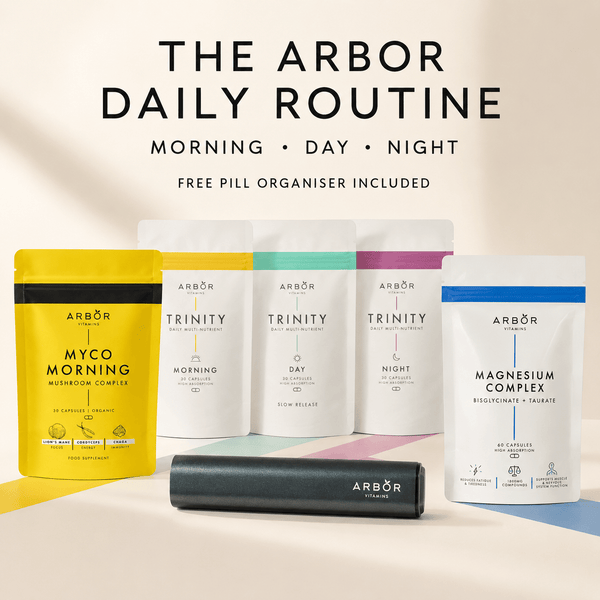
TRINITY Multi-Nutrients separates nutrients into:
-
Morning
-
Day
-
Night formulas
Designed to optimise absorption rather than prioritise stacking.
Explore the full formulation here:
👉 https://arborvitamins.com/products/trinity-formula
FAQ: Do Multivitamins Work?
Do multivitamins actually work?
They can improve micronutrient status, particularly in individuals with dietary gaps or increased demand.
Why don’t I feel different?
Multivitamins prevent deficiency rather than create immediate stimulation.
Are cheap multivitamins effective?
Form, structure and mineral competition influence effectiveness.
Is a structured multivitamin better?
Separating competing nutrients may improve absorption efficiency.
Final Thoughts
Multivitamins aren’t magic.
But they aren’t meaningless either.
They work best when:
-
There is a genuine need
-
Absorption is optimised
-
Mineral competition is reduced
-
Structure supports physiology
Convenience fills a pill.
Structure supports biology.