Tablet vs Capsule vs Powder: What Absorbs Best?
The Science of Supplement Form & Bioavailability
When choosing a supplement, most people focus on:
-
The ingredients
-
The dose
-
The brand
Few people consider the form.
Tablet.
Capsule.
Powder.
Does it matter?
Yes — because absorption begins with dissolution.
Before a nutrient can be absorbed, it must first be released from its delivery system.
Let’s compare.
1️⃣ Tablets: Durable but Highly Compressed
Tablets are made by compressing powdered ingredients into a solid shape.
Advantages:
✔ Stable
✔ Long shelf life
✔ Lower cost to manufacture
But high compression may:
-
Slow dissolution
-
Require more binders and flow agents
-
Increase digestive heaviness
Some tablets contain:
-
Microcrystalline cellulose
-
Magnesium stearate
-
Talc (in some low-cost formulations)
These aren’t necessarily harmful — but they’re often used to improve manufacturing efficiency rather than absorption.
👉 Related: Are Cheap Multivitamins a Waste of Money?

2️⃣ Capsules: Faster Dissolution, Fewer Binders
Capsules typically contain powdered nutrients inside a dissolvable shell (often HPMC or gelatin).
Advantages:
✔ Faster dissolution
✔ Fewer compression binders
✔ Often gentler on digestion
✔ Cleaner ingredient lists
Because capsules don’t require heavy compression, they often contain fewer manufacturing additives.
This can improve:
-
Tolerance
-
Release speed
-
Simplicity of formulation
However, absorption still depends on:
-
Nutrient form
-
Dose
-
Timing
-
Competition
See:
👉 How Vitamin & Mineral Absorption Actually Works
3️⃣ Powders: Flexible & Rapid Release
Powders dissolve before ingestion (or rapidly after).
Advantages:
✔ Rapid availability
✔ Adjustable dosing
✔ No compression
But powders can:
-
Taste unpleasant
-
Require measuring
-
Be less convenient
Absorption may be efficient — but only if taken properly (with fat for fat-soluble vitamins, separated from competing minerals, etc.).
4️⃣ Gummies: Palatable but Limited
Though popular, gummies often:
-
Contain added sugars
-
Deliver lower doses
-
Avoid certain minerals (due to stability issues)
They prioritise taste and compliance.
They rarely optimise for mineral competition or structural timing.
5️⃣ Dissolution Comes First
Before absorption, a supplement must:
-
Dissolve
-
Release nutrients
-
Survive digestion
-
Compete for transport
If dissolution is delayed or incomplete, absorption may decline.
This is particularly relevant for:
-
Large compressed tablets
-
High-mineral stacking
-
Heavy binder use
6️⃣ But Form Isn’t Everything
Capsules don’t magically solve:
-
Mineral competition
-
Dose saturation
-
Fat-soluble timing
-
Circadian alignment
Structure still matters.
👉 Read: One-a-Day Multivitamins vs Structured Multi-Nutrient Systems
So Which Absorbs Best?
There is no universal winner.
But generally:
-
Capsules dissolve faster than heavily compressed tablets
-
Powders offer rapid release but require correct use
-
Tablets are durable but may rely more heavily on binders
Absorption ultimately depends on:
-
Nutrient form (e.g., glycinate vs oxide)
-
Timing
-
Dose size
-
Separation of competing minerals
Form is part of the equation — not the entire equation.
Where Clean, Structured Systems Fit In
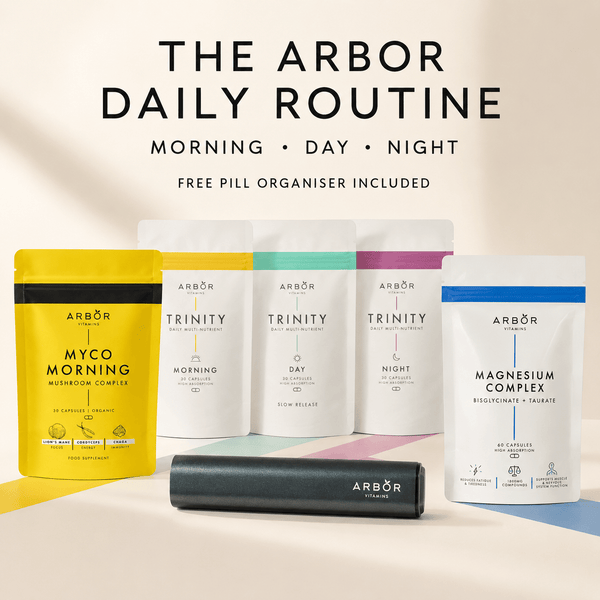
TRINITY Multi-Nutrients uses capsule-based formulas separated across:
-
Morning
-
Day
-
Night
Designed to:
-
Avoid heavy compression
-
Reduce mineral competition
-
Align nutrients with biological rhythm
-
Minimise unnecessary fillers
Explore the full formulation here:
👉 https://arborvitamins.com/products/trinity-formula
FAQ: Supplement Forms & Absorption
Do capsules absorb better than tablets?
Capsules often dissolve faster and may contain fewer binders, which can improve release — but absorption also depends on nutrient form and timing.
Are tablets harder to absorb?
Highly compressed tablets may dissolve more slowly, but quality manufacturing can still allow effective absorption.
Are powders better than capsules?
Powders allow flexible dosing and rapid availability, but correct timing and pairing still matter.
Do gummies absorb well?
Gummies are convenient and palatable but may contain lower doses and fewer mineral options.
Final Thoughts
Before nutrients can be absorbed, they must be released.
Dissolution matters.
Form matters.
But structure matters more.
Capsule vs tablet is important.
But separating competing minerals and aligning with physiology is strategic.
Convenience is simple.
Absorption requires design.