One-a-Day Multivitamins vs Structured Multi-Nutrient Systems
Which Approach Is Better for Absorption, Timing & Mineral Balance?
Most multivitamins follow a simple model:
Everything.
In one tablet.
Taken once daily.
It’s convenient.
It’s familiar.
It’s easy to market.
But is it biologically optimised?
As research into nutrient absorption, mineral competition and circadian biology has advanced, a different approach has emerged: structured multi-nutrient systems.
Let’s compare the two.
The One-a-Day Model
Traditional multivitamins typically combine:
-
Iron
-
Calcium
-
Magnesium
-
Zinc
-
B vitamins
-
Fat-soluble vitamins (A, D, E, K)
All compressed into a single daily tablet.
The appeal is obvious:
✔ Simplicity
✔ Compliance
✔ Low cost
✔ One routine
But absorption is not passive — and not all nutrients behave well when stacked together.
Problem 1: Mineral Competition
Certain minerals share intestinal transport pathways.
For example:
-
Iron and calcium compete for absorption
-
Zinc and copper influence each other’s balance
-
Magnesium absorption decreases at higher single doses
When multiple competing minerals are delivered simultaneously, absorption efficiency may decline.
This doesn’t mean they cancel each other out completely — but it can reduce proportional uptake.
Learn more:
👉 Vitamins You Shouldn’t Take Together (and Why Nutrient Timing Matters)
👉 How Vitamin & Mineral Absorption Actually Works

Problem 2: Dose Saturation
Some nutrients rely on active transport systems.
These systems can become saturated.
Taking 500 mg at once does not guarantee 500 mg absorbed.
High single-dose stacking may:
-
Reduce proportional absorption
-
Increase digestive discomfort
-
Increase excretion
See:
👉 Does Splitting Supplements Improve Absorption?
Problem 3: No Consideration of Timing
One-a-day formulas ignore biological rhythm.
Yet nutrient function varies across the day:
-
B vitamins support daytime energy metabolism
-
Iron absorbs best away from calcium
-
Fat-soluble vitamins require dietary fat
-
Magnesium often supports evening relaxation
Taking everything at once does not account for this.
See:
👉 Best Time to Take Vitamins: Morning vs Night
Problem 4: Tablet Compression & Dissolution
Many conventional multivitamins are:
-
Highly compressed
-
Binder-heavy
-
Designed for shelf stability
While durable, high compression can influence dissolution speed.
Absorption begins with dissolution.
See:
👉 Are Cheap Multivitamins a Waste of Money?
The Structured Multi-Nutrient Approach
A structured system separates nutrients across the day rather than stacking them into one large dose.
Typically this means:
-
Morning formula
-
Day formula
-
Night formula
This allows:
✔ Separation of competing minerals
✔ Alignment with circadian biology
✔ Reduced digestive load
✔ More intentional nutrient pairing
Example of Structured Timing
| Time of Day | Nutrients | Why This Works |
|---|---|---|
| Morning | Iron + Vitamin C + B Complex | Supports energy and iron uptake without calcium interference |
| Midday (with food) | Vitamin D3 + K2 | Improves fat-soluble absorption |
| Evening | Magnesium Glycinate + Zinc | Supports relaxation and avoids iron competition |
Structure doesn’t mean complexity.
It means reducing unnecessary bottlenecks.
Bioavailability Still Matters
Structure alone isn’t enough.
The form of each nutrient also matters.
For example:
-
Magnesium glycinate is generally more bioavailable than magnesium oxide
-
Iron bisglycinate is often gentler than ferrous sulphate
-
Chelated zinc forms may improve tolerance
See:
👉 Magnesium Glycinate vs Magnesium Oxide
Where TRINITY Fits In
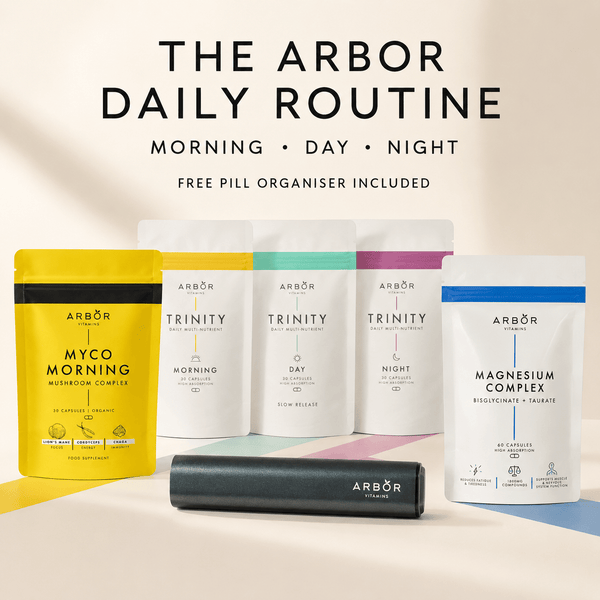
TRINITY Multi-Nutrients is one example of a structured, split-dose system.
It separates nutrients into:
-
Morning
-
Day
-
Night formulas
Designed to:
-
Separate iron from calcium
-
Balance zinc with copper
-
Align energising nutrients earlier
-
Provide magnesium in the evening
-
Avoid unnecessary fillers
Instead of prioritising convenience stacking, it prioritises absorption logic.
Explore the full formulation here:
👉 https://arborvitamins.com/products/trinity-formula
Which Is Better?
One-a-day multivitamins prioritise convenience.
Structured multi-nutrient systems prioritise:
-
Absorption
-
Timing
-
Mineral balance
-
Digestive tolerance
For some people, convenience may be sufficient.
For those focused on optimisation, structure may offer advantages.
FAQ: One-a-Day vs Structured Multivitamins
Are one-a-day multivitamins ineffective?
Not necessarily, but stacking competing minerals and ignoring timing may reduce absorption efficiency.
Does splitting nutrients improve absorption?
Separating competing minerals and aligning nutrients with meals may improve proportional uptake.
Why does timing matter?
Circadian biology, mineral competition and fat-dependent absorption influence how efficiently nutrients are used.
Is structured supplementation better?
Structured systems may reduce mineral competition and align nutrients more effectively with physiology.
Final Thoughts
The question isn’t:
“Can you take everything at once?”
You can.
The question is:
“Is it optimised?”
Absorption is regulated.
Minerals compete.
Timing influences tolerance.
Convenience is simple.
Structure is strategic.