Why Your Multivitamin Might Not Be Working
The Hidden Reasons Supplements Sometimes Underperform
You take a multivitamin.
You’re consistent.
You eat reasonably well.
And yet… you still feel tired. Flat. Deficient. No different.
So what’s going on?
If your multivitamin “isn’t working,” the issue usually isn’t effort — it’s absorption.
Because swallowing nutrients is not the same as absorbing them.
Let’s break down why.
1. Dose on the Label ≠ Dose Absorbed
Supplement labels show how much of a nutrient is inside the capsule.
They do not show:
-
How much dissolves
-
How much survives digestion
-
How much competes with other minerals
-
How much enters circulation
-
How much becomes biologically active
Absorption is regulated and competitive.
If you haven’t read it yet, start here:
👉 How Vitamin & Mineral Absorption Actually Works

2. Mineral Competition Is Real
Many multivitamins combine:
-
Iron
-
Calcium
-
Zinc
-
Magnesium
Into one tablet.
The problem?
Some minerals share transport pathways in the small intestine.
Examples:
-
Iron competes with calcium
-
Zinc competes with copper
-
Magnesium absorption declines at high single doses
Taking them together may reduce efficiency.
Learn more:
👉 Vitamins You Shouldn’t Take Together
👉 Does Splitting Supplements Improve Absorption?

3. Timing May Be Working Against You
Taking everything at once ignores:
-
Circadian rhythm
-
Digestive cycles
-
Mineral competition
B vitamins may feel overstimulating late at night.
Magnesium may be better tolerated in the evening.
Fat-soluble vitamins absorb best with meals containing fat.
See:
👉 Best Time to Take Vitamins: Morning vs Night
4. Form Matters More Than Most People Realise
Not all nutrient forms absorb equally.
For example:
-
Magnesium oxide is less bioavailable than magnesium glycinate
-
Iron sulphate may cause more irritation than iron bisglycinate
-
Zinc oxide may absorb differently than chelated forms
Choosing the right form influences:
-
Tolerance
-
Absorption efficiency
-
Gastrointestinal comfort
Related:
👉 Magnesium Glycinate vs Magnesium Oxide
5. Dose Saturation: Bigger Isn’t Always Better
Some nutrients use active transport systems.
These systems can saturate.
Meaning:
Taking 1,000 mg does not mean absorbing 1,000 mg.
Large single doses may increase waste or digestive discomfort.
Splitting doses can improve proportional uptake.
6. Digestive Conditions Matter
Absorption depends on:
-
Adequate stomach acid
-
Healthy bile production
-
Intestinal integrity
Low stomach acid may impair iron and mineral absorption.
Poor gut health may reduce nutrient uptake.
7. Your Multivitamin Might Be Designed for Convenience — Not Physiology
Most one-a-day multivitamins prioritise:
-
Simplicity
-
Marketing-friendly dosing
-
Broad coverage
They do not necessarily prioritise:
-
Mineral separation
-
Nutrient timing
-
Absorption synergy
For comparison:
👉 One-a-Day Multivitamins vs Structured Multi-Nutrient Systems
So What Actually Helps?
Instead of:
Everything.
All at once.
Consider:
-
Separating competing minerals
-
Aligning energising nutrients earlier
-
Taking fat-soluble vitamins with food
-
Spacing higher mineral doses
-
Choosing bioavailable forms
Structure improves efficiency.
A Structured Alternative
One approach to reducing absorption bottlenecks is separating nutrients across the day.
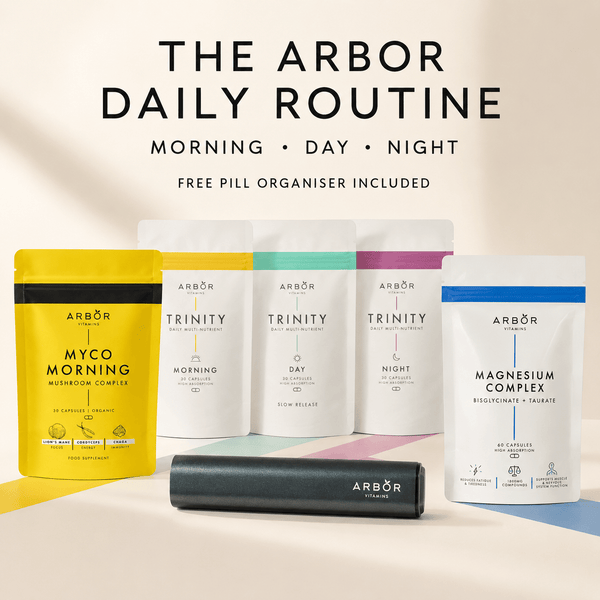
TRINITY Multi-Nutrients uses:
-
Morning
-
Day
-
Night formulas
Designed to:
-
Separate iron from calcium
-
Balance zinc and copper
-
Align energising nutrients earlier
-
Provide magnesium in the evening
You can explore the formulation here:
👉 https://arborvitamins.com/products/trinity-formula
FAQ: Why Multivitamins Don’t Always Work
Why don’t I feel different after taking a multivitamin?
Absorption efficiency, mineral competition, nutrient form and timing all influence how much your body actually uses.
Can minerals cancel each other out?
They don’t cancel completely, but some compete for shared transport pathways.
Is taking everything at once a problem?
For certain minerals and higher doses, it may reduce absorption efficiency.
Should I split my supplements?
In many cases, spacing competing nutrients improves proportional absorption.
Final Thoughts
If your multivitamin isn’t working, it may not be the idea of supplementation that’s flawed.
It may be the structure.
Absorption is biological.
Competition exists.
Timing matters.
Optimising structure can improve efficiency.