⚖️ Vitamins You Shouldn’t Take Together
(And Why Nutrient Timing Can Make or Break Absorption)
| Combination | What Happens in the Gut | Why It Matters | Better Strategy |
|---|---|---|---|
| Iron + Calcium | Compete for intestinal transport pathways | Calcium can reduce non-heme iron absorption | Take iron separately, ideally with vitamin C |
| Iron + Magnesium (high dose) | Magnesium may interfere with iron uptake | Reduced iron absorption when taken together in larger doses | Take iron earlier; magnesium later |
| Zinc + Copper (imbalanced doses) | Excess zinc reduces copper absorption over time | Long-term imbalance may affect copper status | Maintain balanced ratio or space higher doses |
| Calcium + Magnesium (large doses) | Compete for absorption when taken in high amounts | Reduced proportional uptake | Moderate doses or split across day |
| Fat-Soluble Vitamins (A, D, E, K) Without Fat | Poor micelle formation in intestine | Reduced absorption into bloodstream | Take with meals containing healthy fats |
| High-Dose Vitamin C + B12 (very large doses) | Vitamin C may degrade B12 under certain conditions | Reduced B12 stability at extreme doses | Separate very high doses if supplementing heavily |
| Multiple High-Dose Minerals in One Tablet | Transport systems may saturate | Lower absorption efficiency overall | Separate competing minerals across the day |
| Iron + Coffee/Tea | Polyphenols bind iron | Reduced iron absorption | Take iron away from coffee/tea |
Most people focus on what vitamins to take.
Far fewer think about when or with what they take them.
But absorption isn’t passive.
Vitamins and minerals rely on:
-
Specific transport proteins
-
Shared intestinal pathways
-
Active transport systems that can saturate
-
Digestive conditions that fluctuate across the day
Take the wrong nutrients together, and you may reduce how much your body actually absorbs.
This is known as nutrient competition — and it’s one of the most overlooked issues in modern supplementation.

🧬 Why Some Vitamins and Minerals Compete
When nutrients reach the small intestine, they don’t simply “soak in.”
They must:
-
Dissolve
-
Bind to transporters
-
Cross intestinal cells
-
Enter circulation
Certain minerals share the same transport proteins.
For example:
-
Iron uses DMT1 transporters
-
Zinc uses ZIP transporters
-
Calcium relies on vitamin D–dependent pathways
-
Magnesium uses both passive and active transport
When multiple high-dose minerals compete simultaneously, absorption efficiency can drop.
If you haven’t read it yet, start here:
👉 How Vitamin & Mineral Absorption Actually Works

🚫 Vitamins and Minerals You Shouldn’t Take Together
Below are the most clinically relevant interactions.
1️⃣ Iron + Calcium
Calcium can inhibit iron absorption, particularly non-heme iron.
They compete within the intestine, and calcium may reduce iron uptake efficiency when taken together in meaningful doses.
Best practice:
Take iron separately from calcium.
Pair iron with vitamin C to enhance absorption.
Related reading:
👉 Taking Iron and Calcium Together? Why Timing Matters
2️⃣ Zinc + Copper
Zinc and copper maintain a delicate balance.
High-dose zinc supplementation can reduce copper absorption over time.
This doesn’t mean they must never be taken together — but ratios matter.
Best practice:
Ensure balanced ratios or separate high doses.
3️⃣ Magnesium + Iron
High doses of magnesium may interfere with iron absorption.
This interaction becomes more relevant when iron status is already low.
Best practice:
Take magnesium later in the day if supplementing iron earlier.
4️⃣ Fat-Soluble Vitamins Without Dietary Fat
Vitamins A, D, E and K require dietary fat for absorption.
Taking them:
-
On an empty stomach
-
With a very low-fat meal
Reduces absorption efficiency.
Best practice:
Take with meals containing healthy fats.
5️⃣ High-Dose Vitamin C + Vitamin B12 (Large Supplemental Doses)
Very high vitamin C doses may degrade B12 in solution under certain conditions.
In practical supplementation ranges, this effect is modest — but spacing extremely high doses can reduce theoretical risk.
🕒 Why Nutrient Timing Matters
Timing solves two major problems:
-
Mineral competition
-
Circadian alignment
Morning aligns with:
-
Cortisol
-
Energy metabolism
-
Iron utilisation
-
B-vitamin activity
Evening aligns with:
-
Nervous system relaxation
-
Muscle recovery
-
Magnesium tolerance
See:
👉 Best Time to Take Vitamins: Morning vs Night
👉 Does Splitting Supplements Improve Absorption?
📊 The Real Problem with “One-a-Day” Multivitamins
Traditional multivitamins often:
-
Combine iron and calcium
-
Stack multiple competing minerals
-
Ignore circadian biology
-
Deliver high single-dose loads
Convenient? Yes.
Optimised for absorption? Not always.
See the comparison:
👉 One-a-Day Multivitamins vs Structured Multi-Nutrient Systems
🔬 Nutrient Synergy vs Nutrient Competition
Not all combinations are bad.
Some are beneficial:
-
Iron + Vitamin C
-
Vitamin D + Vitamin K2
-
B vitamins together (metabolic pathways overlap)
-
Magnesium glycinate in the evening
The goal isn’t separation for the sake of it.
It’s intelligent pairing.
🧠 How a Structured System Reduces Competition
Instead of:
Everything.
All at once.
A structured approach:
-
Separates iron from calcium
-
Balances zinc and copper
-
Aligns energising nutrients earlier
-
Places calming minerals later
This reduces transport competition and improves tolerance.
🧩 How TRINITY Solves This Structurally
TRINITY was designed around absorption science — not convenience stacking.
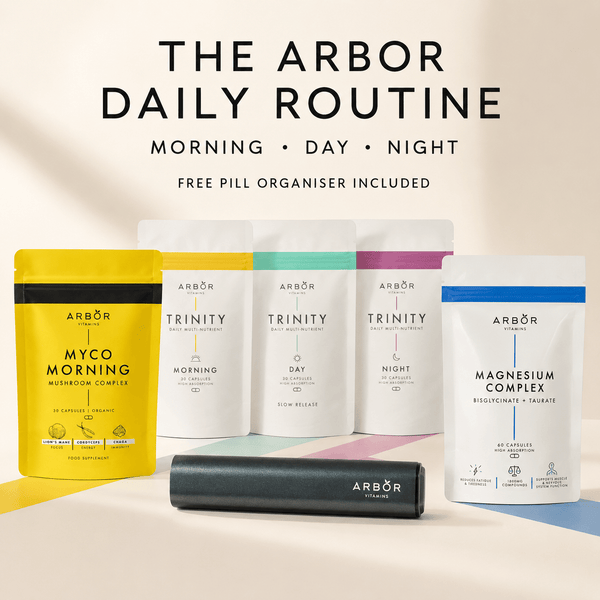
It separates nutrients into three timed formulas:
| Formula | Key Nutrients | Why It’s Structured This Way |
|---|---|---|
| Morning | Iron + Vitamin C + Full B Complex | Enhances iron uptake and supports daytime energy without calcium interference |
| Day | Vitamin D3 + K2 + B6 + B12 + Iodine | Taken with food to optimise fat-soluble absorption |
| Night | Magnesium Glycinate + Zinc + Selenium | Calming minerals placed later to reduce iron competition and support recovery |
This allows:
-
Reduced mineral bottlenecks
-
Synergistic pairing
-
Improved tolerance
-
Logical timing
👉 Explore TRINITY here:
https://arborvitamins.com/products/trinity-formula
🧠 Summary
Taking all your vitamins together may be convenient.
But convenience doesn’t equal optimisation.
Some nutrients compete.
Some require fat.
Some saturate.
Some align better with specific times of day.
Absorption is biological — not marketing.
When nutrients are structured intelligently, efficiency improves.
❓ FAQs
Which vitamins should not be taken together?
Iron and calcium, zinc and copper, and high-dose magnesium with iron are common examples. These nutrients may compete for absorption pathways in the intestine.
Can I take all my vitamins at once?
You can, but separating competing minerals and aligning nutrients with meals may improve absorption efficiency.
Does nutrient timing really matter?
Yes. Mineral competition and circadian rhythm influence how efficiently certain nutrients are absorbed and tolerated.
How do I maximise vitamin absorption?
Take fat-soluble vitamins with dietary fat, pair iron with vitamin C, separate competing minerals and avoid stacking high-dose minerals in one sitting.