When Is the Best Time to Take Functional Mushrooms?
The best time to take functional mushrooms depends mainly on which mushroom you are using and why you are taking it.
As a practical guide:
-
Lion’s Mane and Cordyceps: morning or daytime.
-
Cordyceps: before exercise if that suits your routine.
-
Reishi: evening or as part of a wind-down routine.
-
Chaga, Tremella, Maitake and Shiitake: any convenient time of day.
There is no established clinical rule that functional mushrooms must be taken at an exact hour to work—or that waiting precisely 30–60 minutes before eating meaningfully improves their effects.
The most important factor is usually consistency: choose a time that fits naturally into your day and that you can maintain.
Quick Timing Guide
| Functional Mushroom | Practical Time to Take It |
|---|---|
| Lion’s Mane | Morning or daytime |
| Cordyceps | Morning or before exercise |
| Chaga | Any time; morning is convenient in a daytime blend |
| Reishi | Evening or before bed |
| Tremella | Any time |
| Maitake | Any time |
| Shiitake | Any time |
| Daytime mushroom blend | Morning or with breakfast |
Morning, Evening or Whenever You Remember?
Timing is primarily about matching the mushroom to the routine you want to create.
Lion’s Mane is commonly used during the day because it is studied mainly in relation to cognitive function and mental performance. Cordyceps is often placed in morning or exercise routines because research has focused largely on physical performance, fatigue and exercise tolerance.
Neither is a conventional stimulant, so you should not expect the immediate effect associated with caffeine or a pre-workout product. Human research into Lion’s Mane has also generally assessed regular use over a period of weeks rather than a single dose taken at a particular time.
Reishi is usually taken in the evening because people commonly use it as part of a relaxation or bedtime routine. This does not mean it has been proven to act as a sleeping tablet—or that taking it at night changes its absorption.
For Chaga, Tremella, Maitake and Shiitake, there is little reason to insist on a particular time. They can be taken whenever they fit most easily into your day.
A Simpler Morning Mushroom Routine
Rather than taking Lion’s Mane with breakfast, Chaga at lunchtime and Cordyceps separately before exercise, a well-designed daytime blend can combine them into one straightforward routine.
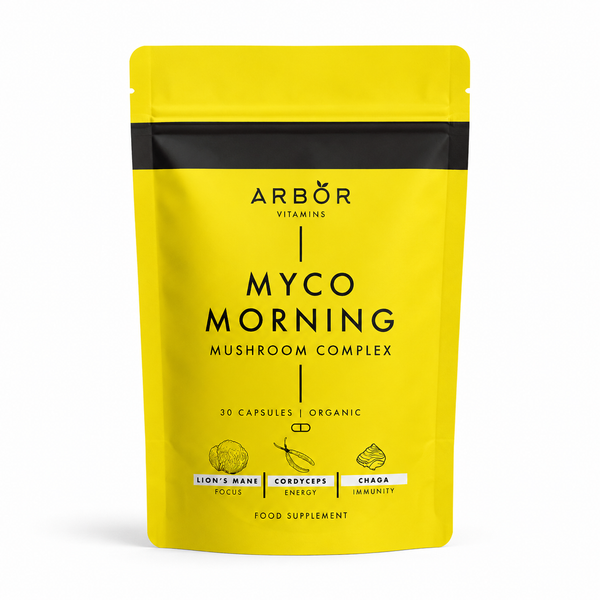
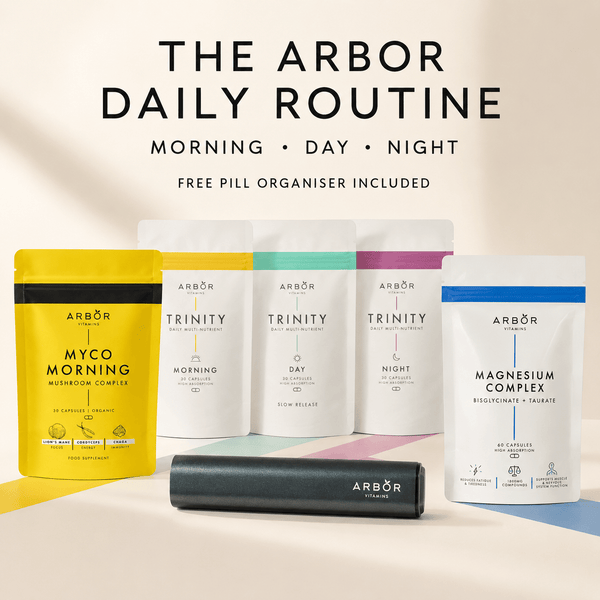
MYCO Morning by Arbor Vitamins contains organic 1:1 extracts of:
-
Cordyceps — 289 mg per capsule
-
Lion’s Mane — 231 mg per capsule
-
Chaga — 58 mg per capsule
Each capsule provides 578 mg of mushroom extracts, using hot-water and ultrasonic extraction, with no binders, fillers or artificial additives. The suggested serving is one to two capsules daily.
Take MYCO Morning:
-
In the morning or earlier part of the day.
-
With a drink of your choice.
-
With or without breakfast, depending on what feels best for you.
-
At roughly the same time each day to help build a consistent routine.
You do not need to fast, wait an hour before eating or create three different mushroom dosing windows.
 Explore MYCO Morning
Best Time to Take Lion’s Mane
Lion’s Mane is most commonly taken in the morning or during the daytime, particularly by people using it as part of a focus, work or study routine.
This is a practical choice rather than a strict biological rule. Human studies have investigated both single doses and regular daily supplementation, with mixed and still-limited findings. Some trials have assessed cognition shortly after a dose, while others have looked at consistent use over several weeks.
Lion’s Mane is not caffeine and should not be expected to provide an immediate stimulant effect.
A sensible routine is to take it:
-
With breakfast.
-
Before starting work or studying.
-
Alongside your morning drink.
-
At another daytime point you can remember consistently.
Some people prefer not to take Lion’s Mane late at night because they feel more alert after using it, but this response is individual rather than an established side effect.
Best Time to Take Cordyceps
Cordyceps is usually taken:
-
In the morning, as part of a daytime routine.
-
Before exercise, when it is being used with physical performance in mind.
Most clinical research has examined Cordyceps over repeated daily use rather than proving that one dose immediately before exercise acts like a conventional pre-workout.
Small studies have reported mixed findings. Some have suggested possible improvements in exercise thresholds or tolerance after several weeks, while others have not found meaningful performance benefits.
Therefore, taking Cordyceps before exercise is mainly a convenient way to connect it with an existing habit. It does not need to be taken exactly 30 or 45 minutes before training.
If you exercise in the evening and find that Cordyceps does not affect your sleep, there is no established reason you cannot take it later. Morning remains the simplest starting point for most people.
Best Time to Take Chaga
Chaga can be taken at any convenient time of day.
Unlike caffeine, Chaga is not an established stimulant. It has also not been shown to be sedating, so there is no convincing reason it must be reserved for either morning or evening.
Most research into Chaga remains laboratory-based or preclinical. Reviews describe potentially interesting polysaccharides and antioxidant compounds, but high-quality human clinical evidence is still limited.
For that reason, claims that Chaga provides an immediate afternoon energy lift, supports “detoxification” or works better at a specific hour should be treated cautiously.
Taking it in the morning is simply convenient when it is combined with other daytime mushrooms.
Can Lion’s Mane, Cordyceps and Chaga Be Taken Together?
Yes, they can be combined in one daytime routine, provided the product is suitable for you and you follow the recommended serving.
There is no need to take:
-
Lion’s Mane at breakfast.
-
Chaga at lunchtime.
-
Cordyceps separately before exercise.
Combining them may make regular use easier and reduces the need to manage several powders, tinctures or individual capsules.
MYCO Morning brings organic extracts of Lion’s Mane, Cordyceps and Chaga together in one capsule-based formula.
Take one to two capsules in the morning or earlier part of the day. They can be taken with breakfast, before work or alongside another habit you already follow consistently.
The best routine is not the most complicated one. It is the one you will actually maintain.
Should You Take Functional Mushrooms With Food or on an Empty Stomach?
Functional mushroom supplements can generally be taken with or without food.
Some brands recommend taking mushroom extracts 30–60 minutes before eating, claiming that food competes with beta-glucans for absorption. However, there is not enough human evidence to show that taking the same mushroom extract on an empty stomach produces better results.
Mushroom beta-glucans are complex polysaccharides that pass through much of the digestive system without being broken down in the same way as ordinary nutrients. Reviews describe possible interactions with the gut microbiota, intestinal cells and immune-associated tissue, but also acknowledge that information about the absorption and pharmacokinetics of orally consumed mushroom beta-glucans remains limited.
In practical terms:
-
Take mushrooms before breakfast when that routine works for you.
-
Take them with breakfast if this is easier to remember.
-
Take them with food if capsules cause nausea or digestive discomfort.
-
Do not skip a dose simply because you have already eaten.
-
There is no need to wait precisely 30 or 60 minutes before having food.
Consistency is likely to matter more than whether your stomach is completely empty.
Can You Take MYCO Morning With Breakfast?
Yes.
MYCO Morning can be taken with a drink of your choice, either alongside breakfast or at another convenient point earlier in the day. The suggested serving is one to two capsules daily.
Taking it with breakfast may be particularly useful if:
-
You have a sensitive stomach.
-
You already take other morning supplements with food.
-
You are more likely to remember it beside your usual breakfast or coffee.
-
Taking capsules without food makes you feel nauseous.
There is no need to create a fasting window around MYCO Morning.
Can You Take Functional Mushrooms With Coffee?
Yes, provided caffeine suits you.
Coffee does not appear to make Lion’s Mane, Cordyceps or Chaga ineffective. Pairing a mushroom supplement with your morning coffee can also make it easier to build a repeatable habit.
However, it is important not to confuse the effects of the two.
Coffee may produce an obvious and relatively rapid stimulant effect. Functional mushrooms should not be expected to create the same immediate caffeine-like lift. When someone feels more alert shortly after taking a mushroom product with coffee, the caffeine may be responsible for much of that immediate sensation.
MYCO Morning itself contains no caffeine, so it can also be taken with water, tea or another drink.
Does Extraction Matter More Than Timing?
The quality and preparation of the mushroom product are likely to matter more than choosing an exact minute of the day.
Mushroom cell walls contain chitin and complex polysaccharides. Extraction is used to release selected compounds from the mushroom material into a more usable powdered extract.
Hot-water extraction is commonly used for water-soluble mushroom polysaccharides, including beta-glucans.
This does not justify claiming that every extract is a fixed number of times more “bioavailable” than every mushroom powder. The finished product still depends on:
-
The mushroom species used.
-
The part of the mushroom included.
-
The extraction process.
-
The extract concentration.
-
The dose provided.
-
Testing and traceability.
-
Whether the quantities are clearly declared.
MYCO Morning uses organic 1:1 mushroom extracts produced using hot-water and ultrasonic extraction. Each capsule supplies:
-
289 mg Cordyceps extract.
-
231 mg Lion’s Mane extract.
-
58 mg Chaga extract.
That provides 578 mg of mushroom extracts per capsule, with no added binders, fillers or artificial additives.
How Long Should You Take Functional Mushrooms?
Do not judge a mushroom supplement solely by whether you feel something after the first capsule.
Research into fungal beta-glucans and individual mushroom extracts has generally assessed repeated use over a period of weeks or months rather than treating them as instant stimulants.
A sensible approach is to:
-
Follow the serving instructions on the product.
-
Take it consistently at roughly the same point in your routine.
-
Pay attention to tolerance and any changes you notice.
-
Reassess after several weeks rather than continually changing the dose or timing.
-
Stop and seek advice if you develop an adverse reaction.
Taking MYCO Morning every day with breakfast is likely to be more practical than taking it occasionally at a supposedly “perfect” time.
Best Time to Take Reishi
Reishi is most commonly taken in the evening, particularly when it forms part of a relaxation or bedtime routine.
A practical time is:
-
With your evening meal.
-
After dinner.
-
Around one hour before bed.
However, Reishi is not a licensed sleeping medicine, and there is not enough human evidence to show that it must be taken at night or exactly one to two hours before bed.
Clinical research into Reishi remains mixed and has examined a wide range of products, doses and health outcomes. An evening routine is therefore mainly based on how people choose to use it rather than proof that the clock changes its effect.
If Reishi does not make you feel relaxed—or you prefer taking all your mushroom supplements together—it can also be taken earlier in the day.
Best Time to Take Tremella
Tremella can be taken at any convenient time.
It is often placed in evening “beauty” blends, but there is no convincing evidence that Tremella:
-
Works better while you sleep.
-
Must be taken before bed.
-
Produces collagen specifically overnight.
Take it at the time you are most likely to remember it consistently.
Best Time to Take Maitake or Shiitake
Maitake and Shiitake can also be taken at any time of day.
Neither is known to act as an immediate stimulant or sedative. When used as extracts, the serving instructions and product quality matter more than whether they are taken at breakfast or dinner.
Can You Take Functional Mushrooms at Night?
Yes—but consider the type of mushroom and your own response.
Reishi commonly fits an evening routine. Lion’s Mane, Cordyceps and daytime blends are usually taken earlier because they are more often used with focus, activity or exercise in mind.
They do not contain caffeine, however, and there is no universal rule that Cordyceps or Lion’s Mane will disturb sleep.
If a daytime mushroom product makes you feel more alert, move it to the morning. If it has no effect on your sleep, taking it later is not automatically a problem.
MYCO Morning is designed as a daytime blend, so morning or early afternoon is the most natural starting point.
Can You Take Morning and Evening Mushroom Products Together?
Potentially, provided:
-
The products do not duplicate excessive amounts of the same extracts.
-
You follow the labelled serving sizes.
-
You introduce new products gradually.
-
You do not have a health condition or medicine interaction that makes them unsuitable.
For example, someone might take Lion’s Mane, Cordyceps and Chaga earlier in the day, then use Reishi separately in the evening.
However, more mushrooms do not automatically produce better results. Start with a simple routine and assess how you respond before adding further products.
Are Functional Mushrooms Safe to Take Every Day?
Many functional mushroom supplements have been used in human studies without serious adverse effects, but the safety evidence differs between species, extracts and doses.
Possible adverse effects include:
-
Digestive discomfort.
-
Nausea or diarrhoea.
-
Headache.
-
Itching or skin reactions.
-
An allergic reaction.
Stop taking the product and seek advice if you develop swelling, breathing difficulty, a widespread rash or another suspected allergic reaction.
Check with a pharmacist or doctor before using functional mushroom supplements if you:
-
Are pregnant or breastfeeding.
-
Have a mushroom allergy.
-
Take warfarin, another anticoagulant or antiplatelet medicine.
-
Take medicines for diabetes.
-
Use immunosuppressant treatment.
-
Have an autoimmune condition.
-
Have significant liver or kidney disease.
-
Are due to have surgery.
Evidence around mushroom–medicine interactions is still incomplete, so caution is sensible where supplements could affect bleeding, blood glucose or immune activity.
For more detailed guidance, read our guide to functional mushroom supplements and medication interactions.
A Practical Daily Routine
For most people, the simplest schedule is:
-
Morning: Lion’s Mane, Cordyceps, Chaga or a daytime blend.
-
Evening: Reishi where it suits a wind-down routine.
-
Any time: Tremella, Maitake and Shiitake.
-
With or without food: choose the option you tolerate and remember best.
There is no need to build your entire day around precisely timed mushroom doses.
MYCO Morning combines Lion’s Mane, Cordyceps and Chaga in one capsule-based morning routine—without requiring separate powders or multiple dosing windows.
Frequently Asked Questions
What is the best time of day to take functional mushrooms?
It depends on the mushroom and why you are taking it.
Lion’s Mane, Cordyceps and daytime blends are usually taken in the morning. Reishi is commonly taken in the evening. Chaga, Tremella, Maitake and Shiitake can generally be taken whenever they fit most easily into your routine.
Should I take functional mushrooms before or after food?
Either is acceptable.
There is not enough human evidence to show that taking mushroom extracts on an empty stomach consistently produces better results. Take them with food if this feels gentler on your stomach or makes them easier to remember.
Can I take functional mushrooms with coffee?
Yes. Coffee does not appear to prevent Lion’s Mane, Cordyceps or Chaga from working.
Remember that any immediate increase in alertness is more likely to come from the caffeine. MYCO Morning contains no caffeine and can also be taken with water, tea or another drink.
Can I take Lion’s Mane and Cordyceps together?
Yes. Lion’s Mane and Cordyceps are commonly combined in daytime mushroom formulas.
MYCO Morning combines both with Chaga, allowing all three extracts to be taken in one morning routine rather than at separate times.
Can I take Lion’s Mane at night?
You can, but morning or daytime is usually the more practical choice.
Some people prefer taking it earlier because they associate it with focus or feel more alert after using it. It is not a conventional stimulant, however, and there is no universal rule that it will interfere with sleep.
Can I take Cordyceps before a workout?
Yes. Cordyceps is often taken before exercise, although it does not need to be consumed at an exact time or treated like an immediate pre-workout supplement.
Regular use and overall training, nutrition and recovery are likely to matter more than taking it precisely 30 minutes before exercising.
Is it safe to take functional mushrooms every day?
Many people use functional mushroom supplements daily, but suitability depends on the mushroom, extract, dose, medicines and individual health.
Follow the product instructions and seek professional advice if you take regular medication, are pregnant or breastfeeding, have a mushroom allergy, or live with a significant medical condition.
How long do functional mushrooms take to work?
There is no reliable universal timeline.
Some people report noticing changes relatively quickly, while others notice little or no obvious effect. Human studies commonly assess regular supplementation over several weeks rather than expecting an instant response from one dose.
How many MYCO Morning capsules should I take?
The suggested serving is one to two capsules daily.
Take them in the morning or earlier part of the day, with or without breakfast. Follow the serving instructions and do not exceed the recommended amount.
Key Takeaways
-
Lion’s Mane and Cordyceps are usually taken in the morning or daytime.
-
Reishi commonly suits an evening routine.
-
Chaga, Tremella, Maitake and Shiitake do not require a particular time.
-
Functional mushrooms can generally be taken with or without food.
-
There is no proven need to wait 30–60 minutes before eating.
-
Consistency and product quality matter more than perfect timing.
-
MYCO Morning combines Lion’s Mane, Cordyceps and Chaga in one simple daytime formula.
Final Thoughts
The best time to take functional mushrooms is not necessarily the time suggested by the most complicated dosing schedule.
Choose a time that:
-
Fits the mushroom you are using.
-
Matches the reason you are taking it.
-
Feels comfortable for your stomach.
-
Is easy to repeat every day.
For Lion’s Mane, Cordyceps and Chaga, morning is a convenient and sensible starting point.
MYCO Morning combines organic extracts of all three in one capsule-based formula, with no caffeine, binders, fillers or artificial additives.
Take one to two capsules in the morning, with or without breakfast, and make consistency the priority.
Related Guides
-
Do Mushroom Supplements Interact With Medications?
-
Cordyceps Benefits: Energy, Exercise Performance and Fatigue
-
Chaga and Diabetes Medication: Can You Take Them Together?
-
Fruiting Body vs Mycelium: Which Mushroom Supplement Is Better?
-
How Functional Mushroom Extraction Methods Work
Selected References
-
Mori K, Inatomi S, Ouchi K, Azumi Y, Tuchida T. Improving effects of the mushroom Yamabushitake (Hericium erinaceus) on mild cognitive impairment: a double-blind placebo-controlled clinical trial. Phytotherapy Research. 2009;23(3):367–372.
-
Hirsch KR, Smith-Ryan AE, Roelofs EJ, Trexler ET, Mock MG. Cordyceps militaris improves tolerance to high-intensity exercise after acute and chronic supplementation. Journal of Dietary Supplements. 2017;14(1):42–53.
-
Vlassopoulou M, Yannakoulia M, Pletsa V, Zervakis GI, Kyriacou A. Effects of fungal beta-glucans on health: a systematic review of randomized controlled trials. Food & Function. 2021;12:3366–3380.
-
Cerletti C, Esposito S, Iacoviello L. Edible mushrooms and beta-glucans: impact on human health. Nutrients. 2021;13(7):2195.
-
Leong YK, Yang FC, Chang JS. Extraction of polysaccharides from edible mushrooms: emerging technologies and recent advances. Carbohydrate Polymers. 2021;251:117006.
About the Author
Written by Jon Wright, Clinical Pharmacist and Co-Founder of Arbor Vitamins.
Jon writes evidence-led guidance on medicines, supplements and functional ingredients, helping readers separate practical advice from exaggerated wellness claims.
Last reviewed: July 2026
Medical Disclaimer
This article is for general information only and does not replace personalised advice from your doctor, pharmacist or another qualified healthcare professional.
Functional mushroom supplements are not intended to diagnose, treat, cure or prevent disease. Evidence varies considerably between mushroom species, extracts and health outcomes.
Speak to a healthcare professional before using functional mushrooms if you are pregnant or breastfeeding, take regular medication, have a mushroom allergy, live with a significant medical condition or are preparing for surgery.
Stop taking the product and seek medical advice if you develop a suspected adverse or allergic reaction.