Why taking all your vitamins at once doesn’t always work
Most people who take supplements are doing something sensible:
they’re trying to fill nutritional gaps and support their health.
What often goes unexamined is how those nutrients are taken — and whether the body can realistically absorb and use them all at the same time.
The idea that you can swallow one capsule, once a day, and neatly “cover everything” sounds convenient. But it doesn’t reflect how human physiology actually works.
Vitamins and minerals don’t act independently. They interact, compete, depend on cofactors, and follow different daily rhythms. When those factors are ignored, supplements can end up being far less effective than expected — even when the doses look generous on the label.
This is where timing, combinations, and formulation start to matter.
Vitamins and minerals don’t work in isolation
Once a supplement reaches the gut, nutrients aren’t absorbed in a vacuum.
Many vitamins and minerals:
-
share the same absorption pathways
-
rely on the same enzymes
-
influence each other’s metabolism
-
or compete for transport into the bloodstream
Because of this, what you take together can influence how much your body actually uses.
Some combinations are well understood to support absorption and function. Others quietly interfere with each other — not because either nutrient is “bad”, but because biology has limits.
Combinations that are known to work well together
Certain nutrient pairings are consistently supported by absorption and metabolism research.
Vitamin C and iron
Vitamin C improves the absorption of non-heme iron (the form found in plant foods and many supplements) by converting it into a form that is easier for the body to take up. This interaction is one of the most consistently demonstrated in nutrition science.
Vitamin D and magnesium
Magnesium is required for vitamin D to be converted into its active form. Without adequate magnesium, vitamin D metabolism becomes less efficient, regardless of intake.
Vitamin D and vitamin K
Vitamin D increases calcium absorption from the gut. Vitamin K activates proteins that help direct calcium into bone tissue. Their roles support the same calcium-regulating system.
Fat-soluble vitamins and dietary fat
Vitamins A, D, E and K are absorbed more effectively when taken with fat. Taking them on an empty stomach can significantly reduce uptake.
These are examples of supportive interactions — cases where nutrients complement each other rather than compete.
When nutrients can get in each other’s way
There are also combinations where timing matters, particularly at supplemental doses.
Calcium and zinc
Calcium, especially at higher supplemental levels, can reduce zinc absorption when taken at the same time.
Zinc and copper
Higher zinc intake increases proteins in the gut that bind copper more strongly than zinc. Over time, this can reduce copper absorption if copper intake is not sufficient.
Magnesium and calcium
Both minerals use overlapping absorption pathways. When taken together in large amounts, they can compete, reducing the fraction absorbed.
None of these nutrients are harmful in isolation. The issue isn’t the nutrient — it’s competition.
Why higher doses don’t always fix the problem
A common response to poor absorption is simply to increase the dose.
On paper, this looks logical.
In practice, the body has limits.
Absorption is not linear. Once transporters or enzymes are saturated, extra intake doesn’t necessarily lead to higher utilisation — it often just increases excretion.
This is why some people take supplements consistently, see impressive numbers on labels, and still feel little difference.
Timing matters more than most people realise
Beyond combinations, timing also plays a role.
The body’s needs, hormone levels, digestive activity and enzyme expression change across the day. Some nutrients align better with daytime metabolism, while others may be better tolerated later.
This doesn’t mean everyone needs an elaborate schedule.
It does mean that a single, all-at-once approach isn’t always optimal.
Splitting intake — or at least being mindful of what’s taken together — can make supplementation more physiologically sensible.
Why this matters for multivitamins
Traditional one-a-day multivitamins prioritise convenience and shelf simplicity. They often contain a wide range of nutrients compressed into a single dose, taken at a single time.
The challenge is that this approach:
-
ignores nutrient competition
-
ignores differing absorption needs
-
ignores timing
-
and assumes higher doses compensate for inefficiency
That doesn’t mean multivitamins are useless.
It means how they’re designed matters.
Formulation, spacing, and balance play a much bigger role than most labels suggest.
A more thoughtful way to approach supplements
From a biological perspective, effective supplementation is less about maximising numbers and more about:
-
compatibility
-
timing
-
balance
-
and realistic absorption
For some people, that means separating certain nutrients.
For others, it means choosing more targeted supplementation.
For others, it means using formulations designed with interactions in mind.
There isn’t a single “right” approach — but there are approaches that align better with how the body actually works.
Key takeaways
-
Vitamins and minerals interact — positively and negatively
-
Some combinations support absorption, others compete
-
Higher doses don’t automatically fix poor utilisation
-
Timing and balance can matter as much as total intake
-
Supplement design matters more than most people realise
Understanding these principles helps explain why some supplements underperform — and why a more considered approach often makes sense.
Does timing really affect vitamin absorption?
Yes. Some nutrients are absorbed better with food, others are influenced by competing minerals or daily metabolic rhythms.
Is it bad to take all vitamins together?
Not inherently, but taking everything at once can reduce absorption of certain nutrients due to competition.
Why don’t one-a-day multivitamins always work well?
Because they prioritise convenience over absorption, timing and nutrient interactions
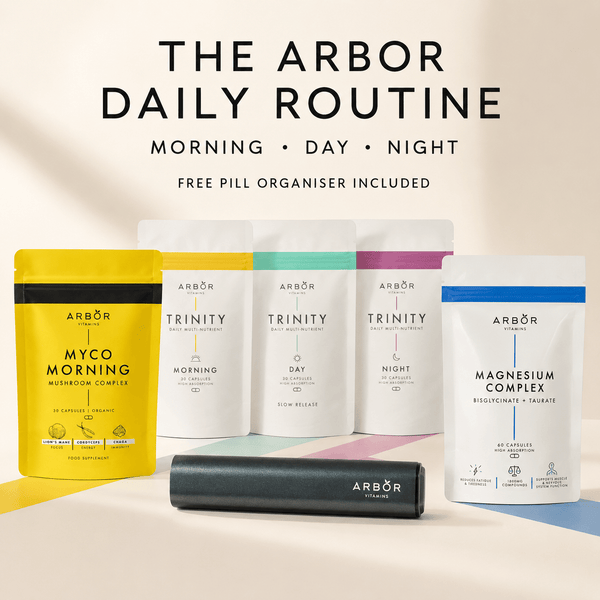
Find out about why we made our product TRINITY.