Lion’s Mane Dosage: How Much to Take, When to Take It and How Long It Takes to Work
Lion’s Mane has become one of the most popular functional mushrooms for people interested in focus, cognitive health and everyday mental performance. But working out how much to take can be surprisingly confusing.
Some products recommend a few hundred milligrams, while others provide several grams. You’ll also find powders, concentrated extracts, fruiting-body supplements and mycelium products—all of which may contain very different amounts of mushroom material and naturally occurring compounds.
Quick Answer
There is currently no universally established clinical dose of Lion’s Mane.
Human studies have used doses ranging from approximately 1,000 mg to 3,000 mg per day, but these studies have tested different powders, extracts and formulations. This means that the number of milligrams on two Lion’s Mane products cannot always be compared directly.
For most supplements, the safest approach is to:
-
Follow the dose recommended by the manufacturer.
-
Check whether the product is a powder or concentrated extract.
-
Choose a product that clearly states which part of the mushroom is used.
-
Avoid assuming that a larger dose will automatically provide greater benefits.
Lion’s Mane Dosage at a Glance
| Question | Quick Answer |
|---|---|
| How much Lion’s Mane should I take? | There is no single established dose. Human studies have commonly tested around 1–3 g per day, depending on the preparation. |
| When is the best time to take it? | There is no clinically proven best time. Many people take it in the morning or during the day. |
| Should I take Lion’s Mane with food? | It can generally be taken with or without food. Taking it with a meal may be more comfortable if you have a sensitive stomach. |
| How long does Lion’s Mane take to work? | There is no guaranteed timeframe. Some studies have examined effects shortly after a single dose, while others assessed daily use over several weeks. |
| Can I take Lion’s Mane every day? | Daily use has been studied for periods ranging from several weeks to several months, although evidence on continuous long-term use remains limited. |
| Is a higher dose better? | Not necessarily. Product quality, preparation and concentration may matter as much as the number of milligrams. |
Pharmacist’s Verdict
The most appropriate Lion’s Mane dose depends on what the product contains, not simply the number printed on the front of the packet.
A concentrated extract cannot automatically be compared with an equivalent weight of plain mushroom powder. Before choosing a dose, look at the form of Lion’s Mane, the mushroom material used, the extraction method and the manufacturer’s recommended serving.
What Doses of Lion’s Mane Have Been Used in Human Studies?
There is no officially established Lion’s Mane dosage. However, human studies give us some indication of the amounts that have been researched.
Importantly, these trials used different Lion’s Mane preparations, participant groups and measures of cognitive performance. Their results cannot be used to prove that one particular dose will work for everyone.
| Study | Lion’s Mane Preparation | Dose and Duration | What Was Found? |
|---|---|---|---|
| Mori et al., 2009 | Dried fruiting-body powder in tablets | 3 g daily for 16 weeks | Cognitive scores improved in adults with mild cognitive impairment at weeks 8, 12 and 16. Scores declined again after supplementation stopped. |
| Saitsu et al., 2019 | Powdered fruiting body | 3.2 g daily for 12 weeks | One measure of cognitive function improved in adults aged 50 and over, although two other cognitive tests did not show significant improvements. |
| Docherty et al., 2023 | Lion’s Mane supplement containing fruiting-body material | 1.8 g daily for 28 days | Participants completed one task more quickly after a single dose. After 28 days, there was a trend towards reduced stress, but most cognitive outcomes were unchanged. |
| La Monica et al., 2023 | Nordic-grown Lion’s Mane fruiting body | Single 1 g dose | Improvements were reported in some individual cognitive measures one to two hours after taking it, but the findings were limited. |
| Grozier et al., 2022 | Lion’s Mane incorporated into food | 10 g daily for four weeks | No significant improvement in cognition or metabolic flexibility was found in the young adult participants. |
| Surendran et al., 2025 | Standardised fruiting-body extract | Single 3 g dose | No overall improvement in cognitive performance or mood was found, although one individual psychomotor task improved. |
What Do These Studies Actually Tell Us?
The research does not show that taking more Lion’s Mane produces better results.
A dose of 10 g per day did not improve cognition in one study, while smaller doses produced limited or mixed findings in others. This suggests that the participant group, duration of use and type of Lion’s Mane preparation may be just as important as the dose itself.
It is also worth noting that some of the more encouraging findings involved:
-
Adults aged 50 and over.
-
People experiencing mild cognitive decline.
-
Daily supplementation lasting eight weeks or longer.
-
Powdered Lion’s Mane fruiting body rather than an undefined mushroom blend.
These results cannot necessarily be applied to healthy younger adults or to every Lion’s Mane product sold commercially.
The Key Point
Human trials have commonly used approximately 1.8–3.2 g of Lion’s Mane per day, but this should be viewed as a researched range—not a medically established recommended dose.
The studies remain relatively small, their findings are mixed and the products tested are not always directly comparable. More research is needed before an optimal daily dosage can be confidently identified.
When Is the Best Time to Take Lion’s Mane?
There is currently no clinically proven best time of day to take Lion’s Mane.
Many people choose to take it in the morning because they are using it as part of a routine intended to support focus and mental performance. However, research has not shown that taking Lion’s Mane in the morning is more effective than taking it later in the day.
Lion’s Mane in the Morning
Morning may be the most convenient option if you:
-
Want to incorporate it into your breakfast routine.
-
Are taking it with other daytime supplements.
-
Want to observe how you respond to it during the day.
-
Prefer not to take several supplements close to bedtime.
Lion’s Mane itself is not a source of caffeine. However, some commercial mushroom products also contain coffee, green tea or other stimulating ingredients, so always check the complete ingredient list.
Can You Take Lion’s Mane at Night?
Yes. There is no strong evidence that pure Lion’s Mane must be avoided in the evening or that it commonly disrupts sleep.
However, individual experiences can vary. If you notice that taking it later in the day makes it harder for you to settle, move your dose to the morning. Equally, there is not enough evidence to recommend Lion’s Mane specifically as a sleep supplement.
Should You Split the Dose?
Some clinical studies have divided the total daily amount into several doses, while others have used one serving per day.
There is currently no good evidence showing that a split dose is more effective. The most practical approach is to follow the instructions supplied with the particular product.
If the recommended serving involves several capsules, splitting them between breakfast and lunch may be more comfortable for some people, but this is a matter of tolerance and convenience rather than a proven requirement.
Should You Take Lion’s Mane With Food?
Lion’s Mane can generally be taken with or without food unless the product instructions say otherwise.
Taking it with breakfast or another meal may be preferable if:
-
You have a sensitive stomach.
-
You experience nausea when taking supplements without food.
-
It helps you remember to take it consistently.
There is not currently enough human evidence to show that taking Lion’s Mane with food meaningfully improves its absorption or effectiveness.
The Practical Answer
For most people, the best time to take Lion’s Mane is the time they can take it consistently and tolerate it comfortably.
Morning or lunchtime is a sensible starting point, particularly when first trying it. However, there is no evidence-based requirement to take it at a particular hour, and the manufacturer’s directions should take priority.
How Long Does Lion’s Mane Take to Work?
There is no guaranteed timeframe for Lion’s Mane to start working.
Some people say they notice changes within days, while others take it for several weeks without experiencing an obvious difference. At present, the research does not provide enough evidence to predict how quickly an individual will respond—or whether they will notice a benefit at all.
Can Lion’s Mane Work Immediately?
A small number of studies have investigated Lion’s Mane after a single dose.
In one trial, participants completed one cognitive task more quickly 60 minutes after taking 1.8 g of Lion’s Mane. Another study reported improvements in selected cognitive measures one to two hours after a 1 g dose.
However, these findings were limited to particular tests and did not demonstrate a broad, immediate improvement in memory, focus or overall cognitive performance.
A more recent study using a single 3 g dose also found no significant overall improvement in cognition or mood, although performance improved on one individual psychomotor task.
This means Lion’s Mane should not be expected to produce an immediate, noticeable effect in the same way as caffeine or a stimulant.
How Long Was Lion’s Mane Taken in Longer Studies?
Longer human trials have generally assessed Lion’s Mane over periods of several weeks:
| Duration | What the Research Found |
|---|---|
| Single dose | Some isolated cognitive measures improved after approximately 60–90 minutes, but overall findings were mixed. |
| Four weeks | A small study reported possible changes in some mood-related measures, while another 28-day trial found mostly unchanged cognitive outcomes. |
| Eight weeks | One study involving adults with mild cognitive impairment first reported significant differences in cognitive scores at this point. |
| 12–16 weeks | Some studies in older adults reported improvements in particular cognitive assessments, although not every test showed a benefit. |
These studies used different Lion’s Mane preparations and involved different populations, so they cannot establish a universal timeline.
How Long Should You Try Lion’s Mane For?
There is no medically established trial period. Based on the available research, someone choosing to take Lion’s Mane may need to use it consistently for several weeks before deciding whether it is providing any noticeable benefit.
A practical approach is to:
-
Follow the manufacturer’s recommended dose.
-
Take it consistently rather than intermittently.
-
Avoid introducing several new supplements at the same time.
-
Assess specific outcomes such as concentration, mental fatigue or perceived stress.
-
Stop taking it if you experience unwanted effects.
You should not continue buying or taking a supplement indefinitely simply because you have been told that it “takes time to build up”. If you have used it consistently for a reasonable period and notice no benefit, it may not be worthwhile for you.
Does Lion’s Mane Build Up in Your System?
You may see claims that Lion’s Mane must “build up” in the body, but this has not been clearly established in human research.
Some proposed effects may require repeated intake over time, but researchers have not yet determined the optimal treatment duration, how its active compounds are absorbed, or how long they remain biologically active in humans.
The Practical Answer
Lion’s Mane is unlikely to produce an obvious instant effect.
Some research has identified limited changes shortly after a single dose, while other findings emerged only after eight to sixteen weeks of daily use. Results remain mixed, particularly in healthy younger adults, so benefits should not be presented as guaranteed.
Consistency matters when evaluating any supplement, but so does having realistic expectations.
Lion’s Mane Powder vs Extract: Why the Dose Is Not Always Comparable
The number of milligrams on a Lion’s Mane label does not tell you everything about the strength or quality of the product.
A 500 mg concentrated extract may not be equivalent to 500 mg of plain mushroom powder. Equally, a product displaying a large “mushroom equivalent” figure may contain a much smaller quantity of actual extract.
Before comparing doses, it is important to understand what type of Lion’s Mane you are taking.
Whole Mushroom Powder
Whole mushroom powder is produced by drying and grinding the mushroom material.
Because it has not been concentrated, products containing plain powder often provide doses measured in grams rather than a few hundred milligrams.
Potential advantages include:
-
Minimal processing.
-
Naturally occurring fibre and mushroom compounds.
-
A preparation similar to those used in some human trials.
However, simply grinding a mushroom into powder may not make all of its compounds readily available. Quality can also vary depending on which part of the mushroom is used and how it was grown.
Lion’s Mane Extract
An extract is produced by processing the mushroom with water, alcohol or another extraction method to draw out particular compounds.
Extracts may be more concentrated than plain powder, meaning a smaller serving can potentially provide a comparable quantity of extracted mushroom material.
However, the word “extract” alone does not confirm potency. Ideally, the manufacturer should explain:
-
Which part of the mushroom was extracted.
-
The extraction method used.
-
Whether the stated dose refers to the extract itself or a mushroom equivalent.
-
Whether the product has been tested for relevant compounds.
What Does an Extract Ratio Mean?
Some supplements display ratios such as 8:1 or 10:1.
In theory, a 10:1 ratio means that 10 kg of starting mushroom material was used to produce 1 kg of extract. A 500 mg serving might therefore be marketed as the equivalent of 5,000 mg of mushroom.
However, extract ratios should be interpreted cautiously.
A larger ratio does not automatically mean:
-
The finished product is more effective.
-
More useful compounds are present.
-
The starting mushroom material was high quality.
-
The product has been tested in human studies.
Extraction yields vary, and mushroom-equivalent figures can make a product look stronger than the amount of extract actually supplied.
When comparing labels, look for the real weight of the extract per serving, rather than relying only on the larger equivalent number.
Fruiting Body vs Mycelium
Lion’s Mane products may contain:
-
Fruiting body – the visible mushroom.
-
Mycelium – the thread-like fungal network from which the mushroom grows.
-
A combination of both.
Both parts contain potentially interesting compounds, but they are not interchangeable.
Fruiting-body products are often chosen for their beta-glucan content, while research into certain compounds known as erinacines has focused largely on specially cultivated Lion’s Mane mycelium.
The problem is not necessarily that one part is always “good” and the other is “bad”. The more important issue is whether the manufacturer clearly states what the product contains.
Some mycelium products are grown on grain and may contain a substantial amount of leftover rice, oats or other growing material. This can increase the starch content and reduce the proportion of fungal material in the finished supplement.
Capsules vs Powder
Capsules and loose powders can contain the same underlying Lion’s Mane ingredient. The format mainly affects convenience and dosing.
| Format | Potential Advantage | What to Check |
|---|---|---|
| Capsules | Convenient, accurately portioned and easier to take consistently | Amount per capsule and number required for a full serving |
| Loose powder | Easy to mix into drinks and adjust the serving | Whether it is plain powder or an extract |
| Liquid extract | Convenient for people who dislike capsules | Actual extract quantity, extraction method and added ingredients |
| Coffee or mushroom blend | Easy to incorporate into an existing routine | Whether the amount of Lion’s Mane is disclosed rather than hidden in a blend |
A product containing “1,000 mg per serving” may require two or four capsules, so always check the serving size rather than looking only at the front of the packaging.
What Should You Look for on the Label?
A transparent Lion’s Mane supplement should ideally state:
-
The scientific name: Hericium erinaceus.
-
Whether it contains fruiting body, mycelium or both.
-
The amount of actual powder or extract per serving.
-
The extraction method.
-
Any extract ratio or standardisation used.
-
All additional ingredients and fillers.
-
Independent testing or quality-control information.
The Key Point
Do not choose a Lion’s Mane dose based on the largest number printed on the label.
A lower quantity of a clearly identified, appropriately extracted ingredient may be more meaningful than several grams of an undefined mushroom blend. Compare the actual preparation, transparency and recommended serving—not milligrams alone.

How Much Lion’s Mane Should You Take?
There is no single Lion’s Mane dose that has been proven to be optimal for everyone.
Although human studies have commonly tested approximately 1–3 g per day, copying a dose from a clinical trial is not always appropriate. The product used in the study may differ considerably from the supplement you have purchased in its mushroom material, concentration and extraction method.
A Sensible Starting Approach
When trying a Lion’s Mane supplement for the first time:
-
Check the actual serving size.
Confirm how many capsules, scoops or drops provide the stated daily amount. -
Identify what the dose represents.
Look for the amount of actual powder or extract—not only a larger “mushroom equivalent” figure. -
Begin with the lowest recommended daily serving.
This allows you to assess how well you tolerate the product before considering the upper end of the manufacturer’s directions. -
Take it consistently.
Lion’s Mane should not be judged solely by whether you feel an immediate effect after one or two doses. -
Do not exceed the label instructions.
There is no good evidence that continually increasing the dose will produce greater benefits.
Choosing a Dose by Product Type
| Product Type | Practical Dosing Consideration |
|---|---|
| Plain mushroom powder | Often supplied in gram-sized servings because it has not been concentrated. |
| Concentrated extract | May provide a smaller serving by weight, but the extraction method and actual extract quantity should be disclosed. |
| Capsules | Check the number of capsules needed to obtain the full daily serving. |
| Mushroom blend | Confirm the individual amount of Lion’s Mane rather than relying on the total weight of the entire blend. |
| Coffee or drink mix | Check for caffeine and whether the Lion’s Mane dose is clearly stated. |
| Liquid extract | Compare the amount of extract per full serving, not simply the number of drops. |
A proprietary blend that provides 2,000 mg of several mushrooms combined does not necessarily contain a meaningful dose of Lion’s Mane. If the individual quantities are hidden, it is impossible to know how much you are receiving.
Can You Take Lion’s Mane Every Day?
Daily use is how Lion’s Mane has most commonly been investigated in longer human studies.
Research participants have taken it every day for periods including:
-
Four weeks.
-
Twelve weeks.
-
Sixteen weeks.
These studies generally suggest that Lion’s Mane is well tolerated over the periods tested. However, they do not prove that continuous use for many months or years is necessary, more effective or completely risk-free.
Lion’s Mane eaten occasionally as a culinary mushroom is also different from taking a concentrated extract every day.
Should You Take Breaks from Lion’s Mane?
There is no clinical evidence showing that Lion’s Mane must be “cycled” or that scheduled breaks improve its effectiveness.
Claims that cycling prevents tolerance or makes Lion’s Mane work better have not been established in human research.
A more useful approach is to review periodically:
-
Whether you have noticed a meaningful benefit.
-
Whether you are experiencing any unwanted effects.
-
Whether the supplement remains worth the cost.
-
Whether your medicines or health circumstances have changed.
If you experience persistent digestive discomfort, headache, a rash or another new symptom, stop taking the product and seek appropriate medical advice.
Should You Increase the Dose if You Cannot Feel It Working?
Not automatically.
Lion’s Mane is not a stimulant, and a lack of an obvious immediate sensation does not necessarily mean that the dose is too low. Equally, taking increasingly large amounts does not guarantee that it will become effective.
Research has not demonstrated a straightforward relationship in which a higher dose produces a greater cognitive benefit.
If you have taken a transparent, good-quality product consistently for several weeks without noticing a worthwhile difference, it may be more sensible to stop than to keep increasing the dose indefinitely.
Who Should Check Before Taking It Daily?
Speak to a pharmacist, GP or other appropriate healthcare professional before taking Lion’s Mane regularly if you:
-
Have an allergy to mushrooms.
-
Take prescription medication.
-
Have a long-term health condition.
-
Are pregnant or breastfeeding.
-
Are preparing for surgery.
-
Have experienced an unexplained reaction to another mushroom supplement.
For more detail, read our complete guide to Lion’s Mane Side Effects: Is It Safe?
The Key Point
Use the lowest clearly stated manufacturer-recommended serving that provides a transparent amount of Lion’s Mane powder or extract.
Do not increase the dose simply because another product displays a larger number or because you cannot feel an immediate effect. Product quality, preparation and consistent use are more informative than chasing the highest possible milligram figure.
Frequently Asked Questions
Is 500 mg of Lion’s Mane enough?
It may be, depending on what the product contains.
A 500 mg serving of a concentrated extract cannot be directly compared with 500 mg of plain mushroom powder. Check whether the label states the actual extract amount, the extraction method and which part of the mushroom is used.
There is no established minimum effective dose that applies to every Lion’s Mane product.
Is 1,000 mg of Lion’s Mane a good dose?
One gram falls within the broad range used in some human research, but that does not make it the correct dose for every product or person.
A 1,000 mg serving may contain:
-
Plain mushroom powder.
-
A concentrated extract.
-
Fruiting body, mycelium or both.
-
Lion’s Mane combined with other mushrooms.
Follow the manufacturer’s directions rather than choosing a dose based only on the total milligram figure.
Can you take too much Lion’s Mane?
There is no clearly defined toxic dose in humans, but that does not mean unlimited amounts are safe.
Taking more than the recommended serving may increase the likelihood of digestive discomfort or other unwanted effects without providing additional benefit. Do not exceed the product instructions unless advised by an appropriate healthcare professional.
Can I take Lion’s Mane on an empty stomach?
Lion’s Mane can generally be taken with or without food.
However, taking it alongside breakfast or lunch may be more comfortable if supplements make you feel nauseous or cause stomach discomfort.
Can I take Lion’s Mane with coffee?
Pure Lion’s Mane does not contain caffeine and is commonly taken alongside coffee.
Be careful with premixed mushroom coffees, as they may already contain caffeine. Combining several caffeinated products could increase symptoms such as jitteriness, palpitations or difficulty sleeping.
Can I take Lion’s Mane with other mushrooms?
Lion’s Mane is frequently combined with mushrooms such as Cordyceps, Chaga and Reishi.
The main issue is whether the label discloses the amount of each individual mushroom. A large total blend dose may contain only a small quantity of Lion’s Mane.
Introducing one product at a time can also make it easier to identify the cause of any unwanted effects.
Can I take Lion’s Mane with vitamins?
There are no well-established interactions between Lion’s Mane and standard vitamin or mineral supplements.
However, check the entire formulation, particularly when using multi-ingredient powders or mushroom blends that may contain additional vitamins, herbs, caffeine or other active ingredients.
What happens if I miss a dose?
Simply continue with your normal serving when the next dose is due.
There is no reason to double the amount to compensate for a missed dose. Missing one serving is unlikely to make a meaningful difference.
Do I need to cycle Lion’s Mane?
There is no good clinical evidence showing that Lion’s Mane needs to be cycled.
Planned breaks may be a personal preference, but claims that cycling prevents tolerance or improves results have not been demonstrated in human studies.
How long can you take Lion’s Mane for?
Human studies have generally investigated daily use for several weeks or a few months.
This provides some reassurance for short-term use, but evidence examining continuous use over many years remains limited. Review periodically whether the supplement is helping and whether you still need to take it.
Final Verdict
There is no single scientifically established Lion’s Mane dosage.
Human studies have commonly used roughly 1–3 g per day, but they have tested different powders, extracts and participant groups, with mixed results. This range should not be treated as a universal dosing recommendation.
For most people, the most sensible approach is to:
-
Choose a transparent, clearly labelled product.
-
Follow the manufacturer’s recommended serving.
-
Start at the lower end of the stated directions.
-
Take it consistently at a convenient time.
-
Avoid increasing the dose simply to chase a noticeable effect.
-
Review whether it provides a meaningful benefit after several weeks.
When comparing products, the preparation, extraction method and quality of the Lion’s Mane are often more important than finding the largest number on the label.
Looking for a Functional Mushroom Blend?
Lion’s Mane is available as a standalone supplement, but it is also commonly combined with other functional mushrooms.
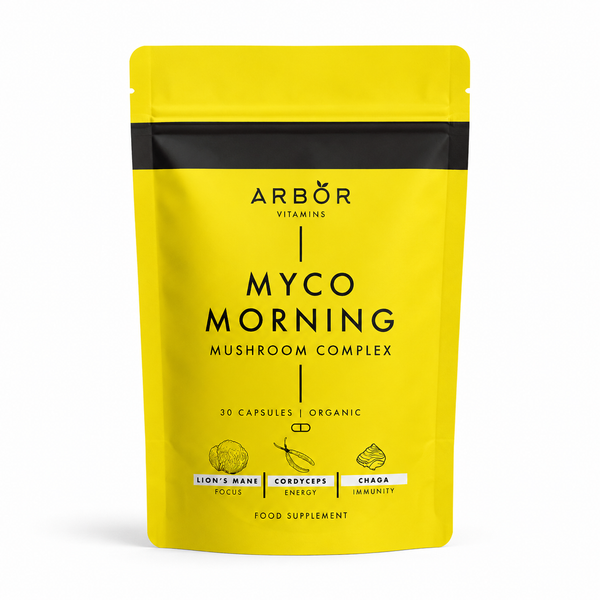
MYCO Morning by Arbor Vitamins combines organic Lion’s Mane, Cordyceps and Chaga fruiting-body extracts in a convenient, caffeine-free capsule. It is intended for people looking for a broader functional mushroom blend rather than a high-dose standalone Lion’s Mane product.
As with any mushroom supplement, follow the recommended serving and check with your pharmacist or GP if you take regular medication or have an existing health condition.
[Explore MYCO Morning]
Further Reading
Learn More About Lion’s Mane
-
Lion’s Mane Benefits: What Does the Evidence Say?
-
Lion’s Mane Side Effects: Is It Safe?
-
Lion’s Mane and Sertraline: Can You Take Them Together?
-
Lion’s Mane and ADHD Medication: Can You Take Them Together?
Understand Mushroom Supplement Quality
-
Fruiting Body vs Mycelium: What’s the Difference?
-
Best Functional Mushroom Extraction Methods Explained
-
How to Choose a High-Quality Mushroom Supplement
-
Do Mushroom Supplements Interact with Medications?
References
-
Mori K, Inatomi S, Ouchi K, Azumi Y, Tuchida T. Improving effects of the mushroom Yamabushitake (Hericium erinaceus) on mild cognitive impairment: a double-blind, placebo-controlled clinical trial. Phytotherapy Research. 2009;23(3):367–372.
-
Saitsu Y, Nishide A, Kikushima K, Shimizu K, Ohnuki K. Improvement of cognitive functions by oral intake of Hericium erinaceus. Biomedical Research. 2019;40(4):125–131.
-
Docherty S, Doughty FL, Smith EF. The acute and chronic effects of Lion’s Mane mushroom supplementation on cognitive function, stress and mood in young adults: a double-blind, parallel-groups pilot study. Nutrients. 2023;15(22):4842.
-
La Monica MB, Fukuda DH, Wang R, et al. Acute effects of naturally occurring guayusa tea and Nordic Lion’s Mane mushroom on cognitive performance. Nutrients. 2023;15(24):5012.
-
Grozier CD, Rauf A, Khan H, et al. Four weeks of Hericium erinaceus supplementation does not impact markers of metabolic flexibility or cognition. International Journal of Exercise Science. 2022;15(2):1379–1395.
-
Surendran G, Doughty FL, Smith EF, et al. Acute effects of a standardised extract of Hericium erinaceus on cognition and mood in healthy young adults: a double-blind, randomised, placebo-controlled study. Frontiers in Nutrition. 2025.
-
Nagano M, Shimizu K, Kondo R, et al. Reduction of depression and anxiety by four weeks of Hericium erinaceus intake. Biomedical Research. 2010;31(4):231–237.