Why Am I Still Deficient Even Though I Take Supplements?
The Overlooked Reasons Blood Levels Don’t Always Improve
You’re taking supplements.
You’re consistent.
You’re doing what you’re supposed to do.
And yet your blood tests still show:
-
Low iron
-
Low vitamin D
-
Borderline B12
-
Suboptimal magnesium
It’s frustrating.
But in many cases, the issue isn’t effort.
It’s absorption, structure, or biology.
Let’s break down why deficiency can persist — even when you supplement.
1️⃣ You May Not Be Absorbing What You’re Taking
Taking a supplement does not guarantee absorption.
Nutrients must:
-
Dissolve
-
Survive digestion
-
Cross intestinal cells
-
Enter circulation
-
Reach target tissues
If any step underperforms, blood levels may not improve.
Start here:
👉 How Vitamin & Mineral Absorption Actually Works

2️⃣ Mineral Competition May Be Reducing Uptake
Certain nutrients compete for absorption pathways.
For example:
-
Iron competes with calcium
-
Zinc competes with copper
-
Magnesium competes at higher doses
If you’re taking multiple minerals together in a single tablet, absorption efficiency may decline.
See:
👉 Vitamins You Shouldn’t Take Together

3️⃣ Timing May Be Working Against You
Iron absorbs best:
-
Away from calcium
-
Away from coffee
-
With vitamin C
Fat-soluble vitamins absorb best with dietary fat.
Magnesium may be better tolerated later in the day.
If everything is taken at once, optimisation drops.
See:
👉 Best Time to Take Vitamins: Morning vs Night
👉 Does Splitting Supplements Improve Absorption?
4️⃣ Dose Saturation & Transport Limits
Some nutrients rely on active transport systems that can saturate.
Taking very high single doses does not guarantee proportionally higher absorption.
In some cases:
-
Smaller split doses improve uptake
-
Large single doses increase excretion
More is not always more.
5️⃣ Form Matters
Not all supplement forms are equal.
Examples:
-
Magnesium oxide vs magnesium glycinate
-
Ferrous sulphate vs iron bisglycinate
-
Zinc oxide vs chelated zinc
More bioavailable forms may improve tolerance and uptake.
See:
👉 Magnesium Glycinate vs Magnesium Oxide
6️⃣ Digestive Health Plays a Major Role
Low stomach acid can impair:
-
Iron absorption
-
Calcium absorption
-
Magnesium absorption
Poor gut integrity can reduce:
-
B12 absorption
-
Fat-soluble vitamin uptake
Chronic digestive issues may impair nutrient status.
7️⃣ Your Body May Be Using Nutrients Faster
Sometimes persistent deficiency isn’t poor intake — it’s increased demand.
Examples:
-
Heavy menstrual bleeding → iron demand
-
Chronic stress → magnesium demand
-
Limited sun exposure → vitamin D deficiency
Absorption is one part.
Demand is another.
8️⃣ Single-Tablet Multivitamins May Not Be Structured for Optimisation
Traditional one-a-day multivitamins prioritise convenience.
They often:
-
Combine competing minerals
-
Ignore circadian timing
-
Deliver large single-dose stacks
For comparison:
👉 One-a-Day Multivitamins vs Structured Multi-Nutrient Systems
What Actually Improves Deficiency Outcomes?
Improving blood levels often requires:
✔ Separating competing minerals
✔ Taking iron with vitamin C
✔ Avoiding coffee around iron
✔ Taking fat-soluble vitamins with food
✔ Splitting larger doses
✔ Choosing more bioavailable forms
✔ Structuring intake across the day
Optimisation is often about structure.
Where a Structured System Helps
Instead of stacking everything into one tablet, a structured multi-nutrient system separates nutrients across the day.
This may:
-
Reduce mineral competition
-
Improve tolerance
-
Improve proportional absorption
-
Support more consistent uptake
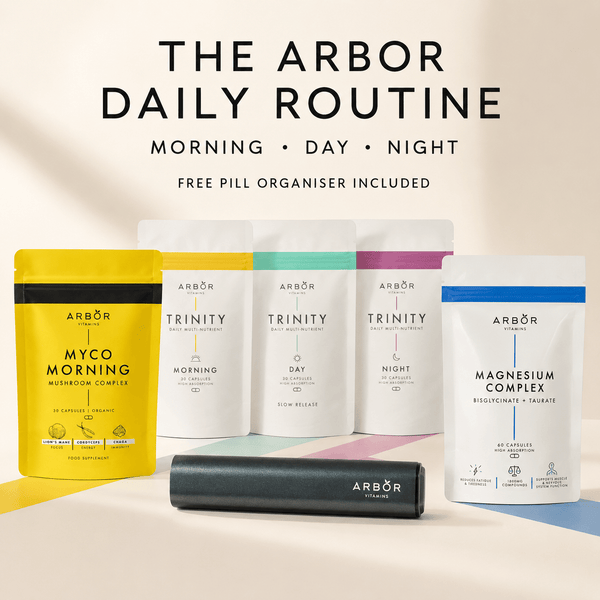
TRINITY Multi-Nutrients separates nutrients into:
-
Morning
-
Day
-
Night formulas
Designed to reduce unnecessary bottlenecks and support more efficient absorption.
Explore the full formulation here:
👉 https://arborvitamins.com/products/trinity-formula
FAQ: Persistent Nutrient Deficiency
Why are my iron levels still low even though I take supplements?
Iron may compete with calcium, be taken with coffee, or be in a less bioavailable form.
Why is my vitamin D still low?
Low fat intake, inconsistent dosing, or limited sun exposure may affect levels.
Can mineral competition really affect blood tests?
Yes. Competing minerals may reduce absorption efficiency over time.
Is taking everything at once reducing absorption?
In some cases, yes — especially with higher mineral doses.
Final Thoughts
Persistent deficiency isn’t always about “not taking enough.”
It’s often about:
-
Absorption
-
Competition
-
Timing
-
Form
-
Digestive health
-
Demand
Optimising structure may improve outcomes more than increasing dose.
Convenience is easy.
Physiology is precise.